
Q‑Day threat: Why 2029 just became the new deadline
Google and Cloudflare just pulled the ‘Q‑Day’ deadline forward to 2029. Here’s what changed, what’s at risk, and how to prepare now.
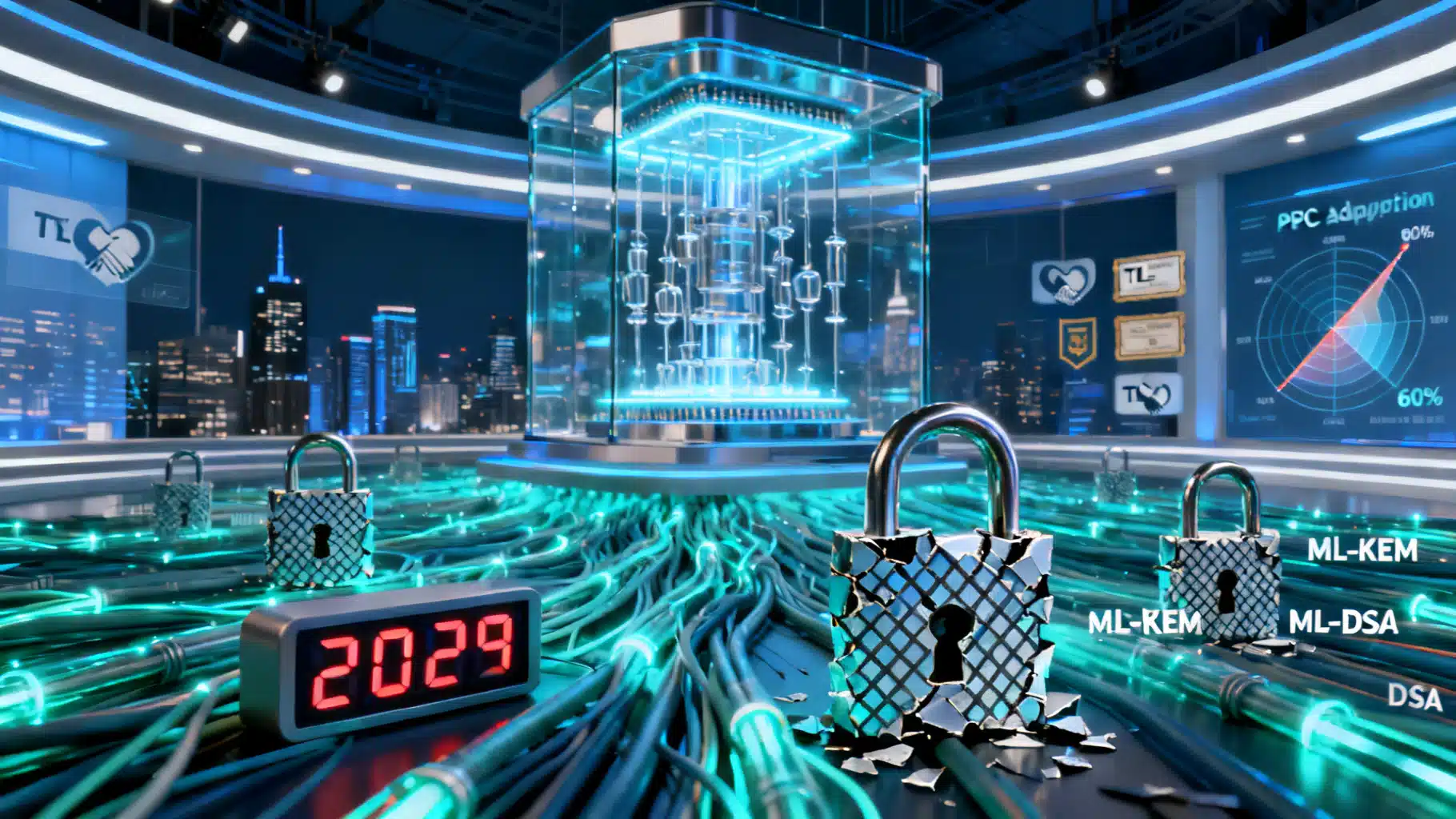
Image used for representation purposes only.
Q-Day threat: Tech giants move the clock forward to 2029
The countdown to “Q‑Day” — the moment when a cryptographically relevant quantum computer can break today’s public‑key encryption — just accelerated. On March 25, 2026, Google publicly set an internal deadline to complete its post‑quantum cryptography (PQC) migration by 2029, citing rapid progress in quantum hardware, error correction, and resource‑estimate research. Cloudflare followed by aligning its own roadmap to 2029, elevating post‑quantum authentication to a top priority. Both dates land years ahead of earlier government windows, resetting assumptions across government and industry. (blog.google )
What “Q‑Day” means — and why it matters now
Q‑Day isn’t the first day a quantum computer exists; it’s the day such a machine can feasibly break widely deployed public‑key schemes (RSA, ECC) used for TLS, VPNs, code‑signing, and identities. That would jeopardize the confidentiality and authenticity of data and software at internet scale. Crucially, attackers can already “harvest now, decrypt later” by stockpiling encrypted traffic for future decryption, so the risk is present today even before Q‑Day arrives. (nist.gov )
The standards are here: NIST’s 2024 PQC rulebook
On August 13, 2024, NIST finalized the first three PQC standards, establishing the cryptographic building blocks for migration: FIPS 203 (ML‑KEM, derived from CRYSTALS‑Kyber), FIPS 204 (ML‑DSA, from CRYSTALS‑Dilithium), and FIPS 205 (SLH‑DSA, SPHINCS+). These standards now anchor U.S. federal procurement and guide global deployments. (csrc.nist.gov )
Government timelines vs. the new 2029 signal
- U.S. federal agencies: OMB Memorandum M‑23‑02 (November 18, 2022) ordered agencies to inventory quantum‑vulnerable crypto and designate migration leads, kicking off a multi‑year transition. (whitehouse.gov )
- NSA/CNSS: Draft CSfC PQC Guidance (April 4, 2025) outlines a CNSA 2.0 timeline: begin transition in 2028, complete by 2030 for registered CSfC solutions; with broader CNSSP‑15 milestones requiring CNSA 2.0 in new products by January 1, 2027, equipment replacement by December 31, 2030, and mandate by December 31, 2031. (nsa.gov )
- NIST deprecation window: A 2025 NIST report drafts a deprecation cadence for vulnerable crypto after 2030 and disallowance after 2035, a window Google explicitly referenced when setting its 2029 deadline. (nvlpubs.nist.gov )
- UK guidance: The NCSC targets full migration by 2035 and urges critical work to start now, framing the change as a “decade‑long, national‑scale” program. (ncsc.gov.uk )
By contrast, Google’s and Cloudflare’s 2029 targets compress the practical timeline for enterprises, particularly for authentication systems and long‑lived digital signatures that are harder to swap out than ephemeral encryption keys. (blog.google )
Evidence the threat clock is ticking faster
Google’s 2025 analysis cut the estimated resources to factor RSA‑2048 to about one million noisy qubits running for roughly a week — a 20× drop from its 2019 estimate. While today’s systems are far smaller and noisier, the trendline and error‑correction improvements justify acting now, especially given harvest‑now‑decrypt‑later risk. (security.googleblog.com )
Real‑world deployments are already shifting
- Web and networks: Cloudflare reports that well over 60% of human‑generated TLS traffic to its network now uses hybrid post‑quantum key exchange, and it just made post‑quantum IPsec generally available to counter harvest‑now, decrypt‑later attacks in site‑to‑site networking. (blog.cloudflare.com )
- Messaging: Apple began rolling out PQ3, a post‑quantum upgrade to iMessage, with iOS 17.4/macOS 14.4 in February 2024. Signal introduced PQXDH in 2023, a hybrid X25519+Kyber handshake for forward‑looking protection. (security.apple.com )
- Platforms: Google says Android 17 is integrating ML‑DSA for post‑quantum signatures in line with NIST, and the company has enabled PQC across Chrome and Cloud services. (blog.google )
What’s at stake on Q‑Day
- Confidentiality: TLS, VPNs, and encrypted archives protected by RSA/ECC become readable if harvested today and decrypted later.
- Integrity and trust: Code‑signing, certificates, and identity systems could be forged if digital‑signature schemes aren’t transitioned in time.
- Long‑lived data: Intellectual property, health records, state secrets, and satellite links must be protected for years or decades, making them priority candidates for early PQC. (cisa.gov )
What organizations should do now
- Establish governance and inventory
- Appoint a crypto‑migration lead and compile a cryptographic bill of materials (CBOM) for applications, protocols, libraries, devices, and vendors. Follow OMB M‑23‑02’s inventory and reporting model if you operate in or sell to the U.S. public sector. (whitehouse.gov )
- Prioritize by risk and data lifetime
- Map where asymmetric crypto protects long‑lived or high‑value data and identities; prioritize those systems first to neutralize harvest‑now‑decrypt‑later exposure. (cisa.gov )
- Adopt NIST‑standard PQC — and plan for agility
- Target ML‑KEM (FIPS 203) for key exchange and ML‑DSA/SLH‑DSA (FIPS 204/205) for signatures. Use hybrid modes during transition where appropriate and design for crypto agility to accommodate future algorithm/profile updates. (csrc.nist.gov )
- Move early on authentication and PKI
- Follow the emerging emphasis on post‑quantum authentication: upgrade certificate profiles, code‑signing, and hardware‑bound trust anchors that are harder to rotate later. Cloudflare and Google are prioritizing signatures now — a cue for enterprise PKI programs. (blog.cloudflare.com )
- Modernize stacks and test performance
- Update cryptographic libraries and negotiate hybrid PQC in TLS 1.3 and IPsec; validate interoperability and performance impacts in your highest‑throughput paths. Cloudflare’s production metrics and IPsec GA are useful references. (blog.cloudflare.com )
- Align with sector and national guidance
- Map roadmaps to CNSA 2.0 and CNSSP‑15 milestones if you support National Security Systems, or to NCSC timelines in the UK — both expect migration well before 2035. (nsa.gov )
The bottom line
Q‑Day remains a forecast, not a fixed date — but the combination of finalized NIST standards, accelerating research cuts to quantum resource estimates, and marquee vendors pulling their deadlines forward to 2029 make the risk materially time‑bound. Waiting invites a backlog of brittle upgrades under duress. Starting now turns Q‑Day from an emergency into an engineering program with clear milestones. (csrc.nist.gov )
Related Posts

Google’s $135 million Android settlement: eligibility, payouts, and key dates
Google will pay $135M to settle claims Android misused cellular data. See eligibility, payout details, and key dates before the June 23, 2026 hearing.
Google’s April 2026: Gemini alliances, tougher rules, a search reset, and I/O on deck
Google’s April 2026: Apple’s Gemini deal, U.S. antitrust remedies, EU DMA pressure, a fresh core update, Android 17 betas, Chrome DBSC, and a $20B bond tap.
Sundar Pichai’s AI Bet: Apple’s Siri Tie‑Up, Record 2026 CapEx, and Gemini Everywhere
Sundar Pichai’s AI era: Apple’s Siri deal, record 2026 CapEx, and Gemini’s rapid expansion—plus the regulatory tests that could shape Google’s future.