Marc Benioff’s big 2026 bet: Agents, a $50B buyback—and a $300M AI token tab
Marc Benioff doubles down on the agentic enterprise with a $50B buyback, Headless 360, and a projected $300M Anthropic token bill—amid investor skepticism.
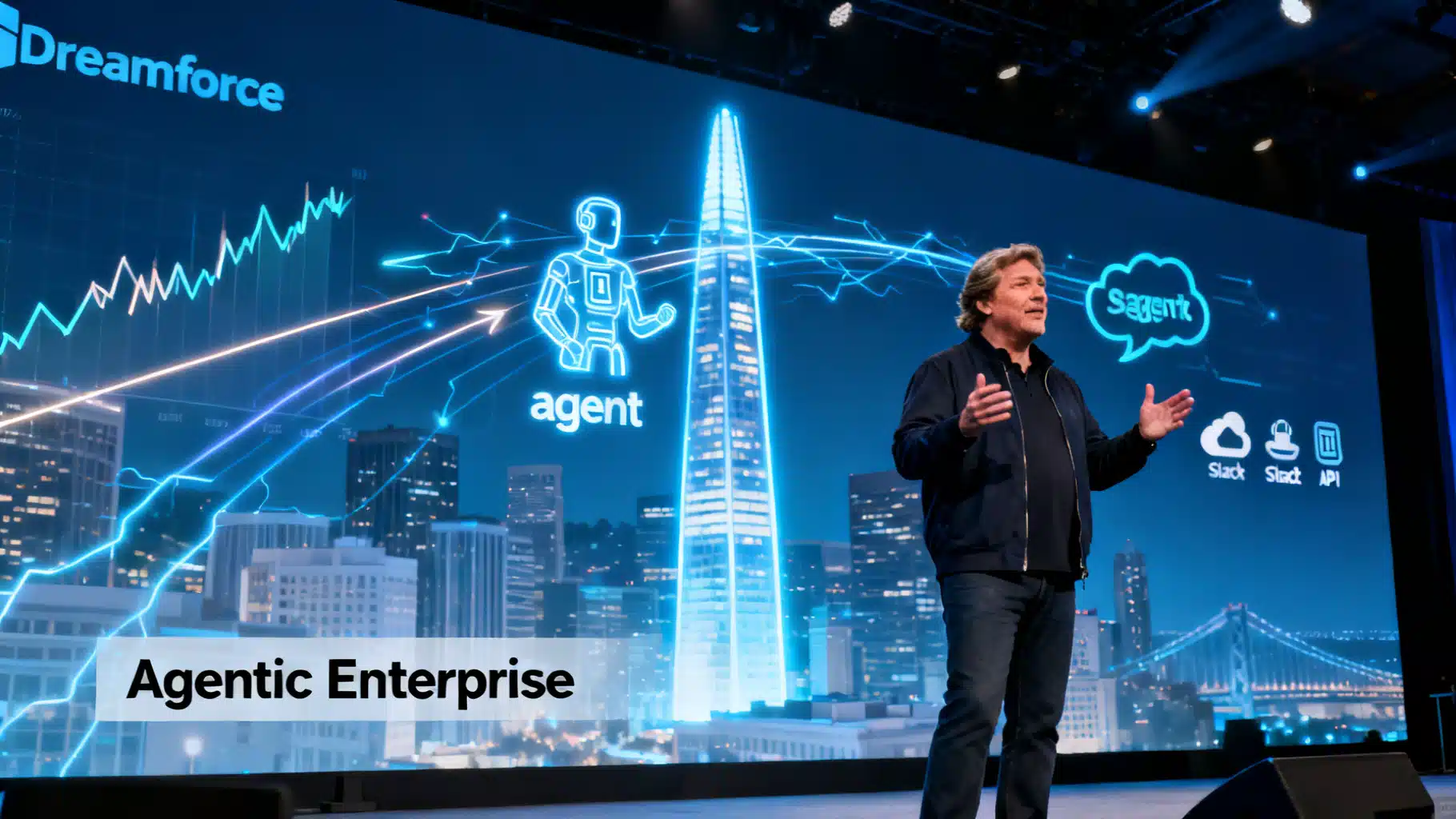
Image used for representation purposes only.
Why Marc Benioff is back in the spotlight
Salesforce chair and CEO Marc Benioff is making an aggressive bet that the “agentic enterprise” will define the next decade of business software—and he’s backing it with eye‑popping spending and Wall Street‑sized signaling. Over the weekend, Benioff said on the All‑In podcast that Salesforce expects to spend about $300 million on Anthropic’s AI “tokens” in 2026, mostly to power coding agents across the company’s stack. The remarks, reported by The Next Web and Yahoo Finance, underscore how AI consumption is becoming a core operating expense for big software makers. (thenextweb.com )
That disclosure lands just weeks after Salesforce launched a record $25 billion accelerated share repurchase as part of a broader $50 billion authorization, and lifted its quarterly dividend to $0.44, up 5.8% year over year—moves Benioff framed as a vote of confidence in Salesforce’s AI transition. (investor.salesforce.com )
The agentic enterprise: Benioff’s core thesis
Benioff’s pitch is that software isn’t dying in an AI “SaaSpocalypse,” it’s being rewritten around autonomous agents that do measurable work on trusted data. He introduced the agentic‑enterprise vision publicly at Dreamforce 2025 with the general availability of Agentforce 360, a platform to build, govern, and deploy enterprise AI agents at scale with Slack as the everyday front end. (techradar.com )
On Salesforce’s February 25, 2026 earnings day, the company doubled down on this framing, introducing “agentic work units” (AWUs) as a new metric to track when an AI agent completes a task—part of a broader effort to move investors beyond raw token counts toward productivity outcomes. TechCrunch captured Benioff’s spirited pushback against fears of a “SaaSpocalypse,” while Axios highlighted the AWU push as a counter to “token‑maxxing.” (techcrunch.com )
Product shift: making Salesforce ‘headless’ for agents
In April 2026 at its TDX developer conference, Salesforce unveiled Headless 360—an architectural turn that exposes core CRM capabilities as APIs, CLI commands, and Model Context Protocol tools so both humans and AI agents can act across the platform without relying on the traditional UI. VentureBeat and Salesforce’s newsroom described more than 100 tools and skills shipping with the initiative, alongside Agentforce Vibes 2.0, a cloud IDE geared for AI‑assisted development. The message: agents need first‑class, governable access to data and actions, not just chat boxes. (venturebeat.com )
Jobs, hiring, and the AI labor mix
Benioff has been unusually candid about how AI is reshaping Salesforce’s workforce. In interviews last fall, he said the company reduced customer support roles from roughly 9,000 to about 5,000 as Agentforce began handling a large share of service interactions—a shift covered by the Los Angeles Times and TechRadar Pro. At the same time, he insists entry‑level opportunities aren’t disappearing, telling Fortune on April 27, 2026 that Salesforce is hiring 1,000 new grads and interns to build its AI platforms, even as some engineering hiring slows in favor of AI‑enhanced productivity. (latimes.com )
The data play: buying Informatica
Benioff’s AI strategy is inseparable from data governance. In 2025, Salesforce signed a definitive agreement to acquire Informatica for about $8 billion and closed the deal in November 2025. The aim: fuse Informatica’s data‑management and MDM chops with Salesforce’s Data 360 so agents work on trusted, well‑labeled, policy‑compliant information. (investor.salesforce.com )
Earnings, buybacks, and the confidence campaign
For the quarter and year ended January 31, 2026, Salesforce reported $10.7 billion in Q4 revenue (up 13% YoY) and $41.5 billion for FY26 (up 10% YoY), while boosting dividends and unveiling that $50 billion repurchase authorization; management also began settling a $25 billion ASR in March. The company touted $72 billion in remaining performance obligation, Agentforce ARR of about $800 million, and the first public breakout of AWUs. The moves were designed to reinforce Benioff’s message that AI agents are a tailwind, not a threat, to the SaaS model. (nasdaq.com )
Still, investor skepticism remains a theme. AP News noted in December 2025 that Salesforce had become a “poster child” for doubt about whether massive AI spending will translate into durable growth—context that helps explain why Benioff is pairing product milestones with shareholder‑friendly capital returns and fresh metrics like AWUs. (apnews.com )
Why the Anthropic spend matters
Benioff’s comment that Salesforce could spend roughly $300 million on Anthropic tokens this year is significant for two reasons. First, it signals that enterprise AI costs are moving from “experimentation” to structurally meaningful OpEx lines. Second, it implies coding is the leading enterprise AI workload today—an area where throughput, reliability, and governance can be measured, not just demoed. Reports by The Next Web and Yahoo Finance tied the planned outlay to coding agents and hinted at model‑routing layers to optimize which tasks hit frontier models like Anthropic’s Claude. (thenextweb.com )
Philanthropy and civic footprint
Separate from the AI drumbeat, Benioff remains one of tech’s most visible philanthropists. Recent Salesforce newsroom features and regional reporting highlight more than $1 billion in Bay Area giving across healthcare, education, and public spaces; recurring support for UCSF Benioff Children’s Hospitals (including an additional $100 million announced in October 2025); and substantial commitments in Hawai‘i, where the Benioffs have expanded health‑care giving. (salesforce.com )
What to watch next
- Token economics vs. productivity: With a projected $300 million token bill, watch whether AWUs and margin trends convince investors that Salesforce’s AI consumption is yielding measurable, repeatable output. (finance.yahoo.com )
- Headless adoption: Developer uptake of Headless 360 and the quality of agent governance/tooling will determine how quickly customers push real work to agents in production. (venturebeat.com )
- Data foundation synergy: Evidence that Informatica + Data 360 accelerates secure, policy‑aware automation will be a key indicator of competitive moat. (salesforce.com )
- Labor model: Expect continued experimentation with a hybrid human/agent workforce—both in how Salesforce staffs internally and in how customers redeploy people toward higher‑value work. (fortune.com )
Bottom line: Benioff is wagering that winning the agent era requires three things—trusted data, measurable outcomes, and the willingness to spend. In 2026, he’s doing all three in public. (nasdaq.com )
Related Posts

CRM Stock: Salesforce’s Record FY26 Can’t Offset Cautious FY27 Outlook
Salesforce’s CRM slips after a record FY26 beat as FY27 guidance and AI pricing questions outweigh a bigger buyback and dividend boost.
Dario Amodei’s High‑Wire Act: Pentagon Clash, White House Talks, and the Rise of ‘Mythos’
Under siege and in demand: How Anthropic CEO Dario Amodei is reshaping AI policy, product strategy, and geopolitics in 2026.
Is Claude Down? Status Check, This Week’s Outage Timeline, and What To Do Now (May 1, 2026)
As of May 1, 2026, Claude is operational. Here’s how to confirm outages, this week’s incident timeline, and what to do if it goes down.