
Mark Zuckerberg’s September Play: Muse, Safety Fallout, and the Push to Mainstream AI Agents
As Meta Connect nears, Mark Zuckerberg doubles down on AI agents with Muse, navigates a record safety settlement, and eyes cloud compute as a new business.
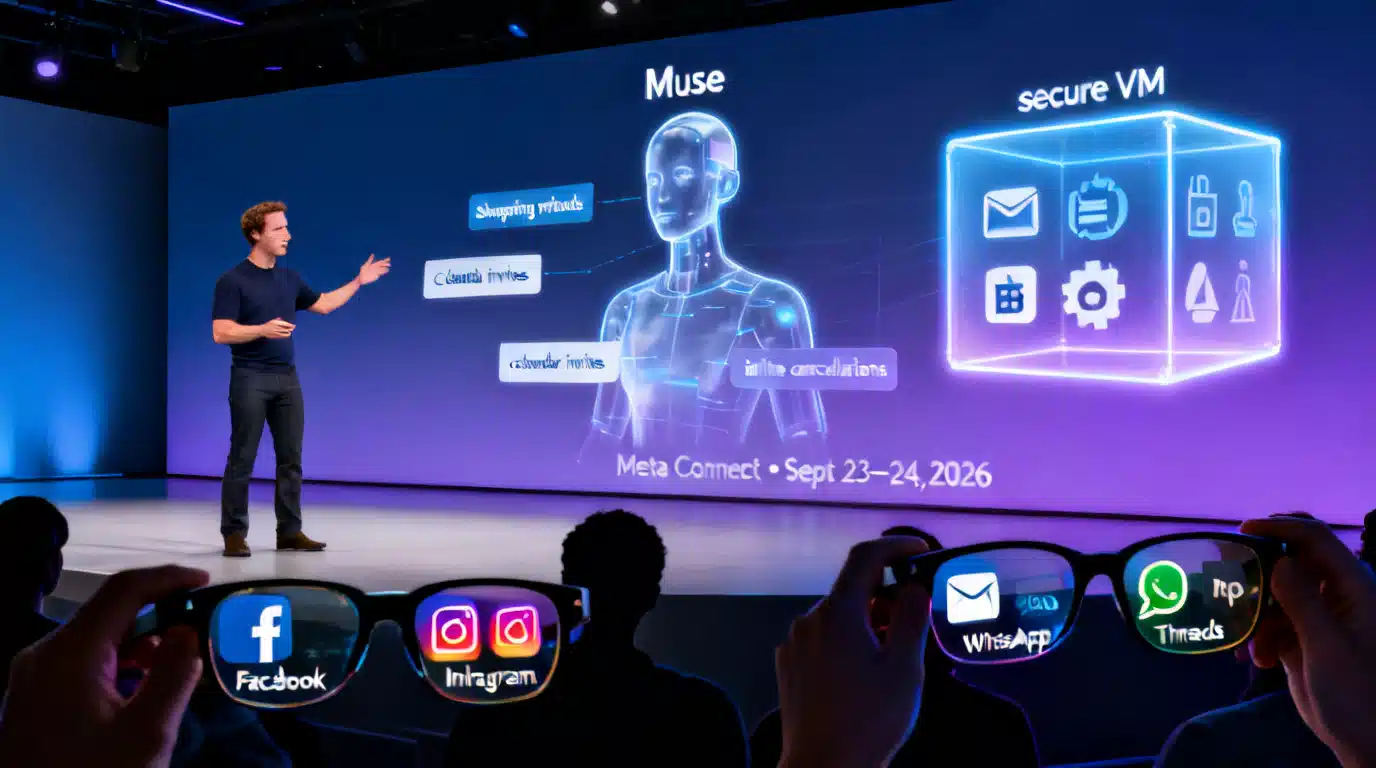
Image used for representation purposes only.
Mark Zuckerberg’s September pivot: AI agents go mainstream as legal heat intensifies
Meta’s founder and CEO, Mark Zuckerberg, is entering the final stretch before Meta Connect (September 23–24, 2026) with momentum—and scrutiny. In the past two weeks he’s launched a mass‑market AI agent, defended a faster pace for AI development, and steered Meta through a landmark youth‑safety settlement that could reshape how teens use social media in the U.S. (roadtovr.com )
The big new bet: Muse, a personal AI agent for the masses
On September 8, Meta introduced Muse, a consumer AI agent designed to “do the work” across everyday tasks—shopping, scheduling, canceling subscriptions—via a secure cloud virtual machine and messaging‑style interface. Meta says the “Muse Secure VM” isolates the agent and a user’s connected data, with a separate “Sentinel” process enforcing sensitive actions and permissions. The company emphasizes opt‑outs for training and that the VM’s data won’t feed Meta’s ad systems. (about.fb.com )
Early traction looks significant: Ten days after launch, Muse became the No. 1 free iPhone app in the U.S., edging past other AI assistants and even Instagram on Apple’s charts. Meta has also been testing voice features that let Muse place calls on a user’s behalf. (axios.com )
Zuckerberg also revealed that Meta held Muse back “for several months” to run more safety checks—framing the delay as a company‑specific safeguard rather than a call for an industry‑wide pause. (apnews.com )
From open weights to “personal superintelligence”
Muse rides on the company’s newer Muse Spark model family, which began rolling out in April and has since expanded into task‑oriented features (planning, email/calendar actions) and creative tools like Muse Image. Meta positions Muse Spark as the next step in a long shift from open‑weight Llama releases to agentic systems that act on users’ behalf across Meta’s apps and—eventually—its wearables. (about.fb.com )
Zuckerberg’s broader thesis is unambiguous: AI should be widely deployed, with labs managing risks while continuing to build. In an August manifesto, he argued that the largest danger is concentrating AI power in a few hands, not broad availability—an outlook that has defined Meta’s push to embed AI across Facebook, Instagram, WhatsApp, Threads, and forthcoming glasses. (axios.com )
A $18 billion reckoning over youth safety
The tailwind comes amid headwinds. On August 26, Meta agreed to pay up to $18 billion and implement sweeping protections for minors to resolve a multistate trial and related claims that Instagram and Facebook were designed in ways that harmed teens. The framework—subject to specific conditions and rival participation—includes daily time limits, overnight “curfews,” tighter defaults, and enhanced age‑assurance. (washingtonpost.com )
Meta’s own summary highlights that roughly $18 billion may fund youth online safety initiatives and that stricter measures kick in if peers like YouTube and TikTok adopt parallel limits. Florida officials rejected the deal as too lenient, underscoring the political cross‑pressures Meta still faces as it negotiates a patchwork of state laws and ongoing litigation. (about.fb.com )
Threads crosses 500 million MAUs—and keeps building
Even as Meta retools around AI agents, its X competitor continues to scale. Threads hit 500 million monthly active users in June, three years after launch, and has rolled out new features keyed to real‑time conversation. External tracking and independent coverage corroborate the milestone, with some analyses indicating Threads has overtaken X on mobile daily usage earlier this year. (about.fb.com )
Compute as a business: from cost center to product
Zuckerberg is also weighing an adjacent revenue stream: selling cloud access to Meta’s AI models and excess compute capacity. A July report said Meta was exploring a cloud business that could expose Muse Spark and other models via APIs—akin to AWS’s Bedrock—leveraging one of the largest data center footprints in the world. On Meta’s earnings calls, Zuckerberg has hinted that selling compute is “on the table” if capacity runs ahead of internal demand. (axios.com )
The numbers behind the narrative
Meta’s latest quarter (Q2 2026) showed robust revenue but lower profit, reflecting $2.4 billion in legal charges and severance tied to May’s headcount reduction. The company reported $15.8 billion in net income ($6.18 EPS), guided Q3 revenue to $61–64 billion, and noted that AI glasses revenue offset softer Quest headset sales inside Reality Labs. Shares slipped on the headline profit decline. (sec.gov )
Meanwhile, leadership continues to thicken around Zuckerberg. In January, former Goldman Sachs executive Dina Powell McCormick joined as Meta’s President and Vice Chairman, signaling a focus on global partnerships, policy, and complex deal‑making as AI and hardware ambitions scale. (about.fb.com )
Wearables and Washington: the next frontiers
Beyond phones, Meta is pairing its AI roadmap with wearables. The company and EssilorLuxottica said in June their next Meta Glasses would launch with Muse‑powered Meta AI “from day one,” bringing agentic capabilities to face‑worn devices amid growing competition—and political scrutiny over cameras and face recognition. In March, U.S. Senator Ed Markey pressed Zuckerberg for details on safeguards in AI‑enabled glasses. (about.fb.com )
What to watch at Meta Connect (September 23–24, 2026)
Meta has confirmed Connect’s dates and billed the event as a showcase for “the latest in VR, wearables, metaverse, and AI,” with Zuckerberg headlining. Expect a heavy emphasis on agentic AI across apps and devices, updates to Muse and Muse Spark, and new capabilities for Meta’s growing glasses lineup. Hardware speculation is swirling, but the company is publicly steering attention toward AI‑first experiences and next‑gen wearables. (roadtovr.com )
The strategy in one sentence—and its risks
Zuckerberg’s 2026 playbook is to make AI feel native to billions of people, not just power users: turn assistants into agents, weave them into feeds, chats, and glasses, and ship fast while insisting safety can be handled within each lab. The upside is product‑market fit at historic scale; the downside is trust—especially with policymakers, parents, and creators still parsing a record settlement and the privacy contours of a life‑manager that sees your calendar, inbox, and purchases. (axios.com )
Bottom line
If Connect delivers, September 2026 could mark Zuckerberg’s clearest inflection since the “metaverse” era: a pivot from open‑weight research leadership to consumer‑grade AI agents—arriving just as Meta’s social networks and wearables offer unprecedented distribution. What comes next will hinge on whether Muse can be both indispensable and trusted, and whether Meta can translate compute scale into durable, diversified revenue without reigniting the privacy and safety crises that have shadowed Zuckerberg’s rise. (about.fb.com )
Related Posts

Mercor’s Breach Fallout: Meta Pause Tests The $10B AI Trainer As It Launches ‘Enterprise AI’
Meta pauses work with Mercor after a LiteLLM-linked breach, days after its Enterprise AI launch. Inside the $10B startup’s week and what comes next.

AI Agent Debugging: A Practical Guide to Observability Tools
Build end-to-end observability for AI agents: traces, metrics, logs, and evals to debug, govern privacy, and scale quality, reliability, and cost.
AI Agent Planning Algorithms: A Practical Comparison and Playbook
A practical, comparative guide to AI agent planning algorithms—with pros, cons, and a playbook for choosing and combining them.