
Why “INS” Is Trending: Rafale M’s First Landing on India’s Carrier INS Vikrant
Rafale M lands on INS Vikrant, spiking “INS” searches. What it means for India’s carriers, Malabar 2026, and Indo-Pacific security.
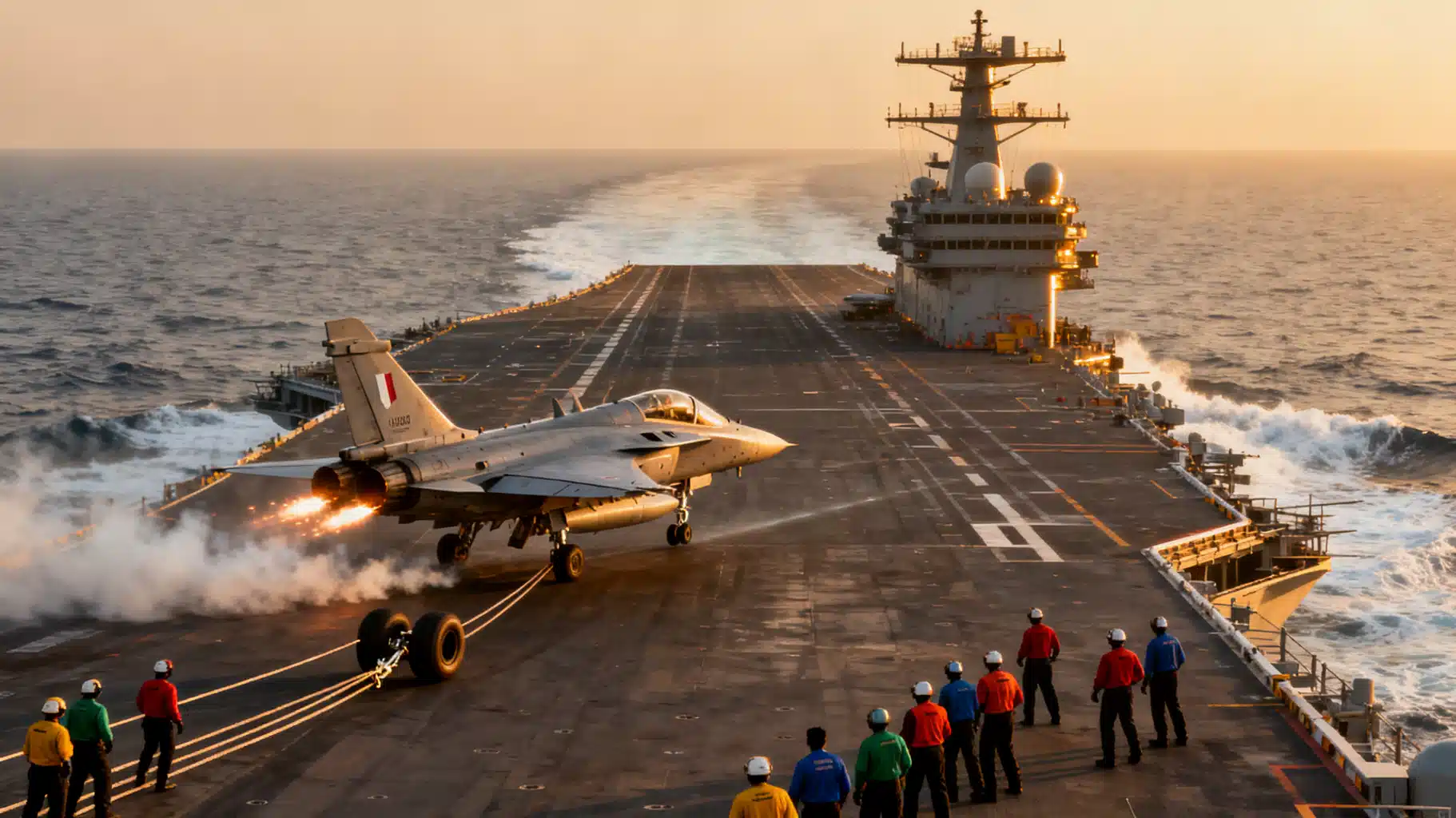
Image used for representation purposes only.
Why “INS” is spiking in searches today
If you noticed “ins” trending in the United States on November 2, 2026, you’re not alone. Search-tracking dashboards point to a burst of interest tied to dramatic footage and reports of a French Rafale Marine (Rafale M) fighter jet making its first deck landing on India’s newest aircraft carrier, INS Vikrant, on October 29. That single milestone—and follow-on trial activity—has pushed the ship’s INS prefix (Indian Naval Ship) into mainstream feeds beyond India. (keywordvelocity.com )
The milestone: Rafale M’s first touch-and-go, arrested landing, and launch
French Navy Rafale M trials aboard INS Vikrant culminated in the fighter’s inaugural landing and subsequent takeoff from the carrier on October 29, 2026, marking a pivotal step in integrating the type with India’s carrier air wing. Independent defense outlets and aviation reporters confirmed the timeline from onboard imagery and official briefings. (navalnews.com )
The trials follow a week of carrier-suitability work at India’s Shore-Based Test Facility (SBTF) in Goa, which replicates ski-jump launches and arrested recoveries to de‑risk at-sea operations. The Navy has signaled only “minor modifications” are required on its carriers to accommodate the Rafale M. (newindianexpress.com )
The deal behind the decks: 26 Rafale M for the Indian Navy
India and France signed an intergovernmental agreement on April 28, 2025, to procure 26 Rafale M fighters—22 single‑seat and four twin‑seat aircraft—for carrier operations. The pact includes technology transfer to integrate indigenous Indian weapons on the jet, aligning with New Delhi’s Aatmanirbhar Bharat (self‑reliance) push. (pib.gov.in )
With the Rafale M now proving itself at sea, observers expect a phased test-and-evaluation program: deck handling and spotting drills, launch/recovery envelopes in different sea states, night qualifications, and weapons trials before full operational clearance on Vikrant. Early Indian coverage underscores why this matters: Vikrant is India’s first indigenous carrier, and Rafale M brings a step-change over the current MiG‑29K fleet in sensors, range, and payload. (livemint.com )
Why this matters beyond India
- Carrier air power is central to maritime deterrence in the Indian Ocean and the Indo‑Pacific writ large. Vikrant’s air wing maturing with the Rafale M will be watched closely by regional navies. (pib.gov.in )
- The trials arrive just as the U.S., India, Japan, and Australia convene Malabar 2026 exercises near Japan from November 5–12, sharpening interoperability among Quad navies. Expect Indian “INS”-prefixed ships to feature prominently in imagery and press notes throughout the week. (news.usni.org )
Other “INS” headlines feeding the trendline
While Vikrant dominates attention, several parallel Indian Navy developments have kept the INS prefix circulating in news feeds over the last 48 hours:
- INS Trishul called at Souda Bay, Greece, on October 31 during a Mediterranean deployment focused on exchanges with the Hellenic Navy. (spsnavalforces.com )
- A minor incident of water ingress aboard INS Kesari was reported at the Naval Dockyard, Visakhapatnam, on November 1; the Navy said the situation was contained and is under assessment. (thenewsmill.com )
INS: what the acronym means (and why Americans are confused)
In Indian naval usage, INS stands for Indian Naval Ship—the prefix applied to commissioned warships of the Indian Navy. The convention echoes global naval prefixes like USS (United States Ship). U.S. naval history sources and Indian government communications both reference INS in this sense. In American civilian contexts, however, INS is also a legacy acronym for the former U.S. Immigration and Naturalization Service—one reason the term routinely spikes with mixed-intent searches. (history.navy.mil )
The road ahead
- Additional Rafale M at‑sea evolutions: Expect progressive expansion of launch-and-recovery envelopes, day/night carrier qualifications, and integration with deck crews in the months ahead as Vikrant advances through its carrier aviation clearance milestones. (navalnews.com )
- Malabar 2026 watchlist (November 5–12): Track how Indian surface combatants (look for the INS prefix) operate alongside U.S., Japanese, and Australian units near Japan’s Kanto region; scenario sets often include air defense, ASW, and complex multi‑ship maneuvers. (news.usni.org )
Key dates at a glance
- October 21, 2026: Indian Navy highlights ongoing Rafale M trials at SBTF Goa; “minor modifications” planned for carriers. (newindianexpress.com )
- October 29, 2026: Rafale M conducts first landing and takeoff on INS Vikrant at sea. (navalnews.com )
- November 1–2, 2026: Global coverage accelerates; explainers detail capability gains for Vikrant’s air wing. (livemint.com )
- November 5–12, 2026: Malabar 2026 scheduled near Japan; watch for more “INS” headlines. (news.usni.org )
Bottom line
“INS” is trending today because India’s indigenous carrier just checked a consequential box on its flight deck. The Rafale M’s first landing on INS Vikrant is more than a viral clip—it’s the opening scene of a multi‑month integration campaign that will shape the Indian Navy’s carrier aviation for years to come, with ripple effects across the Indo‑Pacific. (navalnews.com )
Related Posts
F‑22 in 2026: Congress extends its runway as deployments and upgrades ramp up
House moves to block F‑22 retirements to 2032 as Raptors surge to Kadena and major upgrades enter test. Here’s what changed—and what to watch next.