
Building an AI Auto‑Tagging Classification API: Architecture, Models, and Best Practices
Design and ship a production-grade AI auto-tagging classification API: models, thresholds, architecture, evaluation, security, and scaling best practices.

Image used for representation purposes only.
Overview
AI auto-tagging turns unstructured content—text, images, audio, or video—into structured labels your systems can search, filter, and analyze. An auto-tagging classification API wraps that intelligence behind a reliable, scalable interface developers can call in real time or batch. This article covers design choices, model strategies, evaluation, operations, and security so you can ship a production-grade tagging service.
Why auto-tagging matters
- Search and discovery: consistent tags improve recall and precision in catalogs and knowledge bases.
- Workflow automation: route tickets, escalate risks, and enrich CRM records without humans in the loop.
- Analytics: roll up content into business-ready categories for dashboards and trend analysis.
- Compliance and safety: flag sensitive, restricted, or policy-violating material.
What an auto-tagging API does
At its core, the API maps an input (document, title + body, transcript, image caption) to one or more tags from a defined taxonomy. Characteristics:
- Multi-label: multiple tags may apply simultaneously (e.g., “Pricing”, “Refunds”).
- Hierarchical: tags can have parents (e.g., “Hardware > Laptops > Gaming”).
- Confidence scoring: each tag includes a probability or score.
- Explanations (optional): rationales, evidence spans, or salient features.
Distinguish from keyword extraction (surface-level signals) and generative tagging (free-form suggestions). Production tagging typically anchors to a curated taxonomy with versioning.
Architecture at a glance
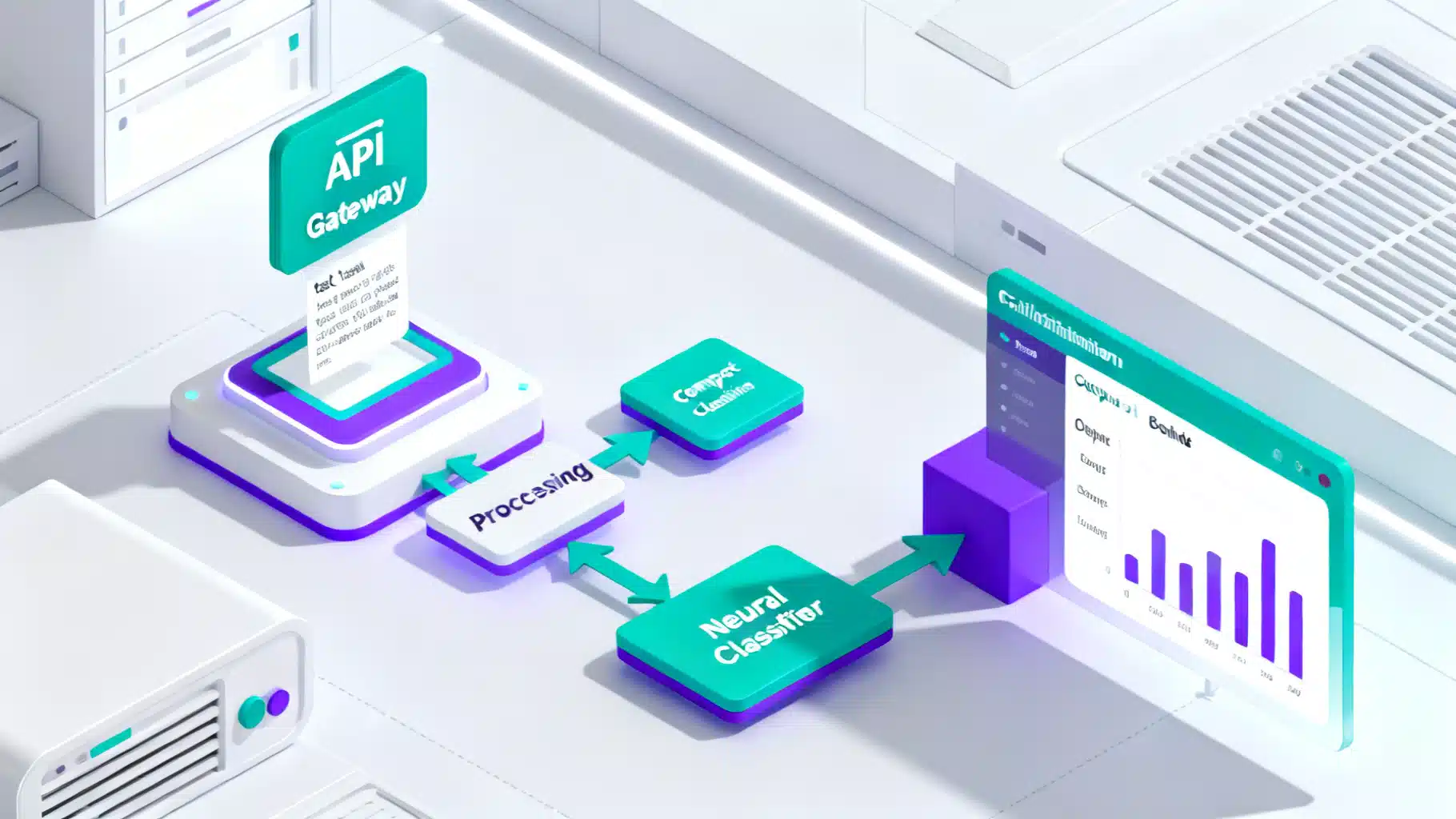
- Ingestion: request hits a gateway (rate limiting, auth), then a tagging service.
- Preprocessing: language detection, normalization, PII redaction, tokenization/chunking.
- Model inference: one or more models predict tag scores.
- Postprocessing: thresholding/top-k selection, hierarchical validation, deduplication.
- Taxonomy service: stores label definitions, synonyms, and versions.
- Feedback loop: human-in-the-loop UI or implicit feedback for retraining.
- Observability: tracing, metrics, structured logs, and audit events.
Taxonomy design and governance
- Scope and granularity: choose 100–2,000 tags for most enterprise cases; start smaller and expand.
- Definitions and synonyms: maintain canonical definitions and alias lists; use these in prompts and embeddings.
- Versioning: immutable versions (e.g., v2026.06) with deprecation windows; store mappings (old → new).
- Hierarchies and constraints: enforce parent-before-child, mutual exclusivity groups, and required-ancestor rules.
- Multilingual labels: include localized names and examples per language.
Model strategies
- Zero-shot or instruction-following LLMs
- How: prompt with taxonomy definitions and ask for applicable tags.
- Pros: rapid iteration, strong generalization, no labeled data initially.
- Cons: token cost, latency, and consistency across versions.
- Tips: few-shot exemplars per label family; tool- or function-style outputs; constrain to known labels; apply post-hoc calibration.
- Embedding similarity
- How: encode document and label descriptions; match via cosine similarity.
- Pros: fast, scalable, label-updatable without retraining.
- Cons: struggles with nuanced distinctions; requires good label descriptions and negatives.
- Tips: use domain-specific embeddings; maintain hard negative sets; rerank with a cross-encoder for top candidates.
- Supervised multi-label classifiers
- How: fine-tune transformer encoders (e.g., BERT/RoBERTa) with sigmoid outputs over labels.
- Pros: strong accuracy, predictable costs, on-prem deployment.
- Cons: needs labeled data and retraining when taxonomy changes.
- Tips: class weights for imbalance; label-wise thresholds; mixup of weak and strong labels.
- Hybrid cascades
- Use embeddings to shortlist 20–50 candidates, then rerank with a cross-encoder or an LLM; combine with a lightweight classifier for high-traffic paths.
Handling long content
- Chunking: split by semantic boundaries (sections, paragraphs). Keep overlaps (e.g., 20–50 tokens) to preserve context.
- Aggregation: max/mean of logits across chunks or learned pooling; require consensus for sensitive labels.
- Evidence spans: return chunk IDs and character offsets for explainability.
Thresholding and calibration
- Global vs per-label thresholds: per-label often yields higher macro-F1.
- Top-k: ensure at least k tags when expected label cardinality is known.
- Dynamic thresholds: adjust based on score distributions per document.
- Calibration: temperature scaling, Platt scaling, or isotonic regression using a validation set.
- Hierarchical rules: if a child is selected, auto-include its ancestors; drop mutually exclusive siblings.
Multilingual considerations
- Detect language cheaply (fast text-based detectors) and route:
- Native multilingual model (mBERT/XLM-R style) for direct tagging, or
- Translate → tag → back-map evidence. Prefer native for high-volume languages; translate for long tail.
- Normalize punctuation, scripts, and variants; maintain locale-specific synonyms.
API design blueprint
- Endpoint: POST /v1/tags
- Request fields:
- content: string (or array for batch)
- content_type: “text” | “html” | “markdown” | “url”
- language_hint: optional ISO code
- taxonomy_version: string (defaults to latest stable)
- candidate_labels: optional subset override
- top_k: integer
- threshold: float or “auto”
- return_explanations: boolean
- return_spans: boolean
- trace_id: string for observability
- Response fields:
- tags: [{ label, score, ancestors: [], evidence_spans: [] }]
- model_version, taxonomy_version
- usage: tokens/latency/billed_units
- request_id, trace_id
OpenAPI snippet
paths:
  /v1/tags:
    post:
      operationId: createTagging
      requestBody:
        required: true
        content:
          application/json:
            schema:
              type: object
              properties:
                content: { type: string }
                content_type: { type: string, enum: [text, html, markdown, url] }
                language_hint: { type: string }
                taxonomy_version: { type: string }
                candidate_labels: { type: array, items: { type: string } }
                top_k: { type: integer, minimum: 1 }
                threshold: { oneOf: [{ type: number }, { type: string, enum: [auto] }] }
                return_explanations: { type: boolean }
                return_spans: { type: boolean }
                trace_id: { type: string }
      responses:
        '200':
          description: OK
          content:
            application/json:
              schema:
                type: object
                properties:
                  tags:
                    type: array
                    items:
                      type: object
                      properties:
                        label: { type: string }
                        score: { type: number }
                        ancestors: { type: array, items: { type: string } }
                        evidence_spans:
                          type: array
                          items:
                            type: object
                            properties:
                              chunk_id: { type: string }
                              start: { type: integer }
                              end: { type: integer }
                  model_version: { type: string }
                  taxonomy_version: { type: string }
                  usage:
                    type: object
                    properties:
                      tokens: { type: integer }
                      latency_ms: { type: integer }
                      billed_units: { type: number }
                  request_id: { type: string }
                  trace_id: { type: string }
Request/response examples
curl -X POST https://api.example.com/v1/tags \
  -H "Authorization: Bearer $TOKEN" \
  -H "Content-Type: application/json" \
  -d '{
    "content": "Customer reports flickering screen after the latest driver update.",
    "content_type": "text",
    "taxonomy_version": "v2026.06",
    "top_k": 5,
    "threshold": "auto",
    "return_explanations": true
  }'
{
  "tags": [
    { "label": "Support/Hardware/Display", "score": 0.92, "ancestors": ["Support", "Hardware"],
      "evidence_spans": [{"chunk_id": "c0", "start": 9, "end": 28}] },
    { "label": "Software/Drivers", "score": 0.81, "ancestors": ["Software"],
      "evidence_spans": [{"chunk_id": "c0", "start": 45, "end": 58}] }
  ],
  "model_version": "mlm-roberta-xxl@1.18",
  "taxonomy_version": "v2026.06",
  "usage": { "tokens": 148, "latency_ms": 126, "billed_units": 1 },
  "request_id": "req_01HX...",
  "trace_id": "trace_1234"
}
SDK quickstarts
Python:
import requests

payload = {
  "content": "Refund requested due to double charge on invoice #442.",
  "content_type": "text",
  "top_k": 3,
  "threshold": 0.65
}

r = requests.post(
  "https://api.example.com/v1/tags",
  headers={"Authorization": f"Bearer {TOKEN}"},
  json=payload,
  timeout=10,
)
print(r.json())
Node.js:
import fetch from 'node-fetch';

const res = await fetch('https://api.example.com/v1/tags', {
  method: 'POST',
  headers: { 'Authorization': `Bearer ${TOKEN}`, 'Content-Type': 'application/json' },
  body: JSON.stringify({ content: articleText, top_k: 5, threshold: 'auto' })
});
const data = await res.json();
Evaluation and QA
Offline metrics:
- Precision/Recall/F1: report micro (volume-weighted) and macro (per-label) scores.
- Label-wise AUC-PR: robust under class imbalance.
- Hierarchical F1: gives partial credit for correct ancestors.
- Coverage and cardinality: average tags per doc; ensure thresholds match expectations.
- Calibration error (ECE): measure probability alignment.
Online metrics:
- Acceptance/edit rate: fraction of tags kept/removed by humans.
- Downstream lift: click-through, search success, or reduced handling time.
- Latency SLOs: p50/p95/p99; error budgets tied to retries.
Validation sets:
- Stratify by source, length, and language.
- Include hard negatives and near-duplicate labels.
- Red-team for sensitive categories and adversarial prompts.
Monitoring and drift
- Data drift: shift in text length, topics, or language mix; alert when embedding centroid distance moves beyond control limits.
- Concept drift: labels change meaning; track per-label F1 and prevalence.
- Explainability: token/feature attributions to debug regressions.
- Tracing: propagate trace_id; sample full payloads with redaction for privacy.
Human-in-the-loop
- Sampling: 1–5% of traffic to review queue.
- Adjudication UI: accept/reject/suggest tags; collect evidence spans.
- Active learning: prioritize uncertain or novel samples.
- Feedback ingestion: versioned datasets; retrain on a cadence with canary releases.
Deployment and scaling
- Serving stack: containerized models behind a low-latency gateway; consider Triton Inference Server or ONNX Runtime for optimized kernels.
- Hardware: GPU for transformer rerankers; CPU for embeddings and lightweight classifiers.
- Throughput math: QPS ≈ instances × batch_size / latency_seconds.
- Batching: micro-batch 8–32 requests to amortize compute; cap with max_wait_ms to protect latency.
- Caching: content-hash cache for idempotent inputs; TTL tuned to taxonomy churn.
- Autoscaling: HPA/KEDA on queue depth and GPU utilization; warm pools to avoid cold starts.
- Optimization: quantization (int8), distillation, sequence length caps, speculative decoding for LLMs.
Cost modeling
- Per-request compute: embeddings (≈ O(n_tokens)), reranker (O(n_candidates)), optional LLM cost per token.
- Storage: taxonomy, logs, and evidence spans.
- Levers: reduce candidate set size, enforce top_k, enable per-label thresholds to cut false positives (and thus human review).
Security, privacy, and compliance
- Authentication: OAuth 2.0 client credentials or mTLS for service-to-service.
- Authorization: per-tenant scopes; label set scoping per project.
- PII hygiene: redact emails, phones, credit cards before storage; configurable DLP policies.
- Encryption: TLS in transit; server-side encryption at rest with key rotation.
- Audit logging: who requested what, when, and which tags were returned.
- Data retention: configurable by tenant with deletion SLAs; comply with regional residency.
- Abuse and safety: rate limits, payload size caps, and WAF rules.
Error handling and SLAs
- Idempotency: Idempotency-Key header to safely retry POSTs.
- Timeouts and retries: exponential backoff with jitter; avoid retry storms by honoring Retry-After.
- Error model: structured problem+json with codes like invalid_taxonomy, throttled, and content_too_large.
- SLOs: 99.9% uptime; p95 < 300 ms for classic paths; separate LLM-enhanced tier with different SLOs.
Common pitfalls and fixes
- Ambiguous labels: add definitions, examples, and negative examples; prefer hierarchical disambiguation.
- Over-tagging: tune thresholds per label; introduce mutually exclusive groups.
- Taxonomy drift: schedule governance reviews; maintain change logs and mapping tables.
- Long documents: chunk with semantic boundaries; aggregate with calibrated pooling.
- Cold start: bootstrap with zero-shot tagging + human validation; backfill historical content in batches.
Build checklist
- Taxonomy: definitions, synonyms, versioning, and constraints exist.
- Data: balanced validation set with hard negatives.
- Models: baseline embedding + reranker; optional LLM cascade.
- API: OpenAPI spec, SDKs, idempotency, and webhooks for async batch jobs.
- Thresholds: per-label calibration and hierarchical enforcement.
- Observability: tracing, per-label metrics, and drift monitors.
- Security: authn/z, encryption, DLP, retention, and audits.
Conclusion
A robust auto-tagging classification API is more than a model endpoint—it’s a carefully engineered system that blends sound taxonomy design, calibrated inference, developer-friendly contracts, and strong operations. Start with a clear taxonomy and evaluation plan, ship a hybrid baseline, close the loop with human feedback, and iterate on thresholds and costs. With these practices, your tags will be accurate, explainable, and reliable at scale.
Related Posts
From Dataset to Endpoint: A Practical AI Text Classification API Tutorial
Build, deploy, and scale a production-ready AI text classification API with Python and FastAPI—training, serving, security, metrics, and monitoring.

AI Summarization APIs for News: Architecture, Quality, and Compliance
Design a reliable AI summarization API for news: architecture, schema, grounding, evaluation, safety, compliance, and cost strategies.
Build a Production‑Ready Predictive Analytics API: A Step‑by‑Step Tutorial
Build a production-ready predictive analytics API with Python and FastAPI—training, serving, security, testing, and MLOps in one tutorial.