
API Governance Policy Enforcement: From Design-Time Guards to Runtime Controls
Practical guide to enforcing API governance with standards, automation, and runtime controls—from design reviews to gateways and OPA.

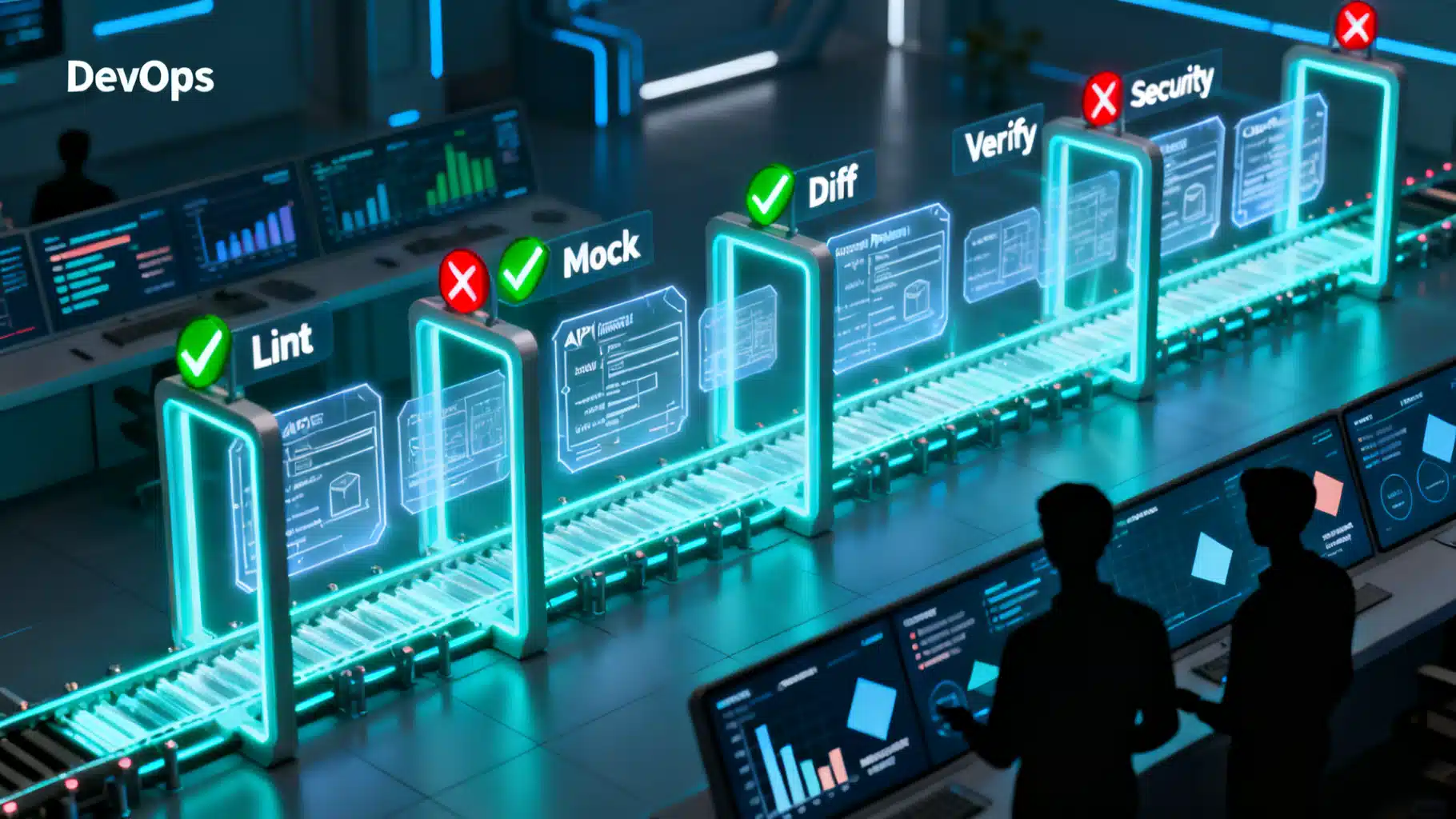
Image used for representation purposes only.
Overview
API governance policy enforcement ensures that every API—from proposal to retirement—conforms to your organization’s standards for quality, security, privacy, and reliability. Done well, it reduces risk, accelerates delivery through consistency, and creates a predictable developer experience.
This guide explains what to enforce, where to enforce it (design-time vs. runtime), and how to operationalize it with policy-as-code, CI/CD gates, and platform controls. You’ll also get examples, a rollout plan, and the metrics that show it’s working.
What to Enforce: Policy Categories
- Design and consistency: naming, versioning, error formats, pagination, idempotency, timeouts, schema hygiene, backward compatibility.
- Security and privacy: authentication, authorization, mTLS/JWT, data classification and masking, PII/PHI handling, rate limits, DDoS/WAF, injection prevention.
- Lifecycle: versioning semantics, deprecation windows, change-notice SLAs, retirement procedures.
- Compliance: audit logging, retention, data residency, consent, industry rules (e.g., PCI DSS, HIPAA), regional privacy laws (e.g., GDPR/CCPA).
- Operational reliability: SLOs/SLAs, circuit breaking, retries, timeouts, health checks, tracing/metrics/logging formats.
Design-Time vs. Runtime Enforcement
- Design-time (shift-left): linters and validators on OpenAPI/AsyncAPI, contract tests, security scanning, architectural review checklists. Goal: block non-compliant designs before code is merged.
- Runtime: gateway, service mesh, and edge controls (authn/z, quotas, schema validation, threat mitigation), plus observability and audit. Goal: consistent, tamper-resistant enforcement in production.
Express Policies as Code
Policies become durable when encoded as machine-checkable rules.
Standardize with OpenAPI
Adopt a shared style guide and reusable components library.
# openapi.yaml (fragment)
openapi: 3.0.3
info:
  title: Accounts API
  version: 1.2.0
x-governance:
  data-classification: internal
  owner: payments-platform
  pii-review-required: true
paths:
  /v1/accounts/{id}:
    get:
      operationId: getAccount
      security:
        - oauth2: [accounts.read]
      responses:
        '200':
          description: OK
          content:
            application/json:
              schema:
                $ref: '#/components/schemas/Account'
Linting with Spectral (example rules)
# .spectral.yaml
extends: spectral:oas
rules:
  ensure-version-prefix:
    description: Paths must start with a version prefix like /v1
    given: $.paths[*]~keys
    then:
      function: pattern
      functionOptions:
        match: ^/v[0-9]+/
  operation-id-casing:
    given: $..operationId
    then:
      function: casing
      functionOptions: { type: camelCase }
  must-define-429:
    description: Rate-limited APIs must document 429
    given: $..responses
    then:
      function: schema
      functionOptions:
        schema:
          type: object
          required: ['429']
Policy-as-Code with OPA/Rego (design gate)
package api.design

# Block release if PII is exposed without auth
violation[msg] {
  some path, method
  api := input.openapi
  op := api.paths[path][method]
  op.security == []  # no security
  op['x-data-classification'] == "pii"
  msg := sprintf("%s %s exposes PII without security", [method, path])
}
CI/CD Enforcement Gates
Baking governance into pipelines prevents drift and makes exceptions auditable.
# .github/workflows/api-governance.yml
name: API Governance
on: [pull_request]
jobs:
  validate:
    runs-on: ubuntu-latest
    steps:
      - uses: actions/checkout@v4
      - name: Install tools
        run: |
          npm i -g @stoplight/spectral-cli
          curl -L -o opa https://openpolicyagent.org/downloads/latest/opa_linux_amd64 && chmod +x opa
      - name: Lint OpenAPI
        run: spectral lint openapi.yaml --fail-severity=warn
      - name: OPA Policy Check
        run: ./opa eval -i openapi.json -d policies 'data.api.design.violation'
      - name: Contract Tests
        run: npm test --workspace=contracts
      - name: Enforce Breaking Changes Policy
        run: npx openapi-diff old.yaml new.yaml --fail-on=breaking
Best practices:
- Fail builds on high-severity violations; allow auto-approval for low-risk warnings with a ticket created automatically.
- Require approval from security/architecture for policy waivers with expiry dates.
- Publish artifacts (OpenAPI, lint reports, SBOMs, and an emerging “API bill of materials”/ABOM) to a registry and catalog.
Runtime Enforcement: Gateways and Mesh
Centralize controls to keep teams fast and consistent.
- Authentication and authorization: OAuth2/OIDC, mTLS between services, fine-grained scopes/permissions.
- Quotas, rate limits, and spike arrest to contain abuse.
- Request/response validation against schemas (size, content-type, numeric/string bounds).
- Content inspection and DLP for sensitive data egress; mask in logs.
- Threat protection: WAF, bot management, IP allow/deny, geo filtering.
- Reliability: circuit breaking, retries with jitter, timeouts.
Example (vendor-neutral YAML style):
# gateway-policy.yaml
api: accounts
rules:
  - name: require-jwt
    type: authn
    config:
      issuer: https://idp.example.com
      audiences: ["payments"]
      required_scopes: ["accounts.read"]
  - name: rate-limit
    type: quota
    config: { requests_per_minute: 600, burst: 100 }
  - name: schema-validate
    type: validation
    config: { openapi_ref: registry://apis/accounts/1.2.0 }
  - name: pii-redaction
    type: dlp
    config: { fields: ["ssn", "cardNumber"], action: mask }
  - name: observability
    type: telemetry
    config: { trace: true, log_correlation: true }
For east–west traffic, a service mesh can enforce mTLS, JWT validation, and retry/timeout budgets without changing app code.
Observability and Audit
If you can’t see it, you can’t govern it.
- Structured logs with trace/context IDs, principal, client, route, policy decisions, and redaction status.
- Metrics: request rates, error codes, latency percentiles, policy violations, throttle counts, auth failures.
- Traces: span tags for tenant, operationId, policy outcomes.
- Immutable audit trail: who changed what policy, when, and why (including waiver lifecycle).
Example structured log:
{
  "timestamp": "2026-09-05T18:42:10Z",
  "trace_id": "c5c2...",
  "route": "/v1/accounts/{id}",
  "principal": "svc:checkout",
  "policy": {
    "jwt": "pass",
    "schema": "pass",
    "quota": "throttled"
  },
  "pii_masked": true,
  "status": 429,
  "latency_ms": 17
}
Data Classification and Privacy by Design
Embed data handling rules into contracts and runtime.
- Label schemas with sensitivity levels (public/internal/confidential/regulated-PII/PHI).
- Use annotations to bind rules.
components:
  schemas:
    Card:
      type: object
      x-data-classification: regulated-pii
      properties:
        cardNumber:
          type: string
          format: credit-card
          x-redact: true
        expiry:
          type: string
        last4:
          type: string
Enforce:
- Consent checks before accessing regulated data.
- Storage and log redaction by default for fields marked x-redact.
- Retention windows and deletion workflows.
- Geo-fencing and residency-aware routing where required.
Note: Coordinate with legal/compliance; this article is not legal advice.
Threat Modeling for APIs (including AI/LLM)
- Map controls to the OWASP API Security Top 10: broken object/authorization, excessive data exposure, lack of resources/rate limiting, mass assignment, SSRF, etc.
- Protect against replay: idempotency keys, short-lived tokens, nonce/clock skew checks.
- Validate webhooks and callbacks with signatures and mutual TLS.
- AI/LLM-specific risks: prompts or tool outputs that can exfiltrate via outbound APIs. Enforce egress allow-lists, DLP, and output filtering for sensitive content.
Operating Model and Roles
- Product owners: define business context, SLAs, and lifecycle.
- Platform team: tooling, gateways/mesh, catalogs, CI/CD enforcement, guardrails.
- Security and privacy: policies, approvals, audits, threat modeling.
- Architecture: standards, versioning strategy, reusable components.
- Developer relations: documentation, training, and feedback loops.
Federated governance works best: central standards with domain teams owning implementation, all mediated by automation.
Metrics That Matter (KPIs)
- Policy coverage: % of APIs with validated OpenAPI and passing linters.
- Drift: runtime vs. declared contract mismatches per month.
- Exception rate and mean time to closure of waivers.
- Change lead time: proposal → approved design → production.
- Reliability: error budget burn, P95/P99 latency, 429 and 401/403 rates.
- Security: authz failures caught pre-release vs. in prod, secret/PII leakage incidents.
- Developer experience: time-to-first-API, PR rejection causes, satisfaction scores.
Maturity Model
- Level 0: Ad hoc, no central standards.
- Level 1: Documented standards; manual reviews; basic gateway usage.
- Level 2: Policy-as-code in CI/CD; cataloged APIs; consistent runtime controls; audit.
- Level 3: Risk-based automation with adaptive policies; continuous conformance dashboards; automated exception expiry and rechecks.
Rollout Roadmap
- Inventory and classify
- Discover all APIs; import specs into a catalog; label owners and sensitivity.
- Define the minimum standard
- A small, enforceable MVP: versioned paths, OAuth2/JWT, 429/401/403 docs, error format, tracing.
- Tool the pipeline
- Add Spectral, OpenAPI diff checks, Rego policies, and contract tests to CI.
- Establish runtime guardrails
- Require gateway/mesh onboarding for new APIs; enable authn/z, rate limits, schema validation.
- Create the exception process
- Ticketed waivers with reason, risk assessment, owner, and expiry.
- Observe and iterate
- Stand up dashboards; review KPIs monthly; expand policies gradually (PII masking, DLP, geo-fencing, retry/timeouts).
30/60/90 focus:
- 30 days: Standards + CI lints + catalog + gateway defaults for new APIs.
- 60 days: Backfill high-risk services; add privacy annotations and redaction.
- 90 days: Automated waiver lifecycle; runtime-vs-contract drift detection; SLO/error-budget guardrails.
Common Pitfalls (and Fixes)
- Big-bang standards nobody reads → Start with a minimal, automated baseline.
- Manual review bottlenecks → Automate checks; reserve humans for edge cases.
- Over-enforcement that breaks DX → Calibrate severities; provide autofixers and templates.
- Shadow APIs bypassing the platform → Make the secure path the easiest path; require gateway onboarding.
- Policies that ignore privacy and egress → Add DLP, egress allow-lists, and logging redaction.
Quick-Start Checklist
- Adopt OpenAPI with a style guide and reusable components.
- Enforce via CI: lints, diff for breaking changes, OPA checks, contract tests.
- Onboard all traffic through gateway/mesh with JWT/mTLS, rate limits, and schema validation.
- Add structured telemetry, PII redaction, and immutable audits.
- Stand up an exception workflow with expirations and reviews.
- Track KPIs and iterate quarterly.
Conclusion
API governance policy enforcement is a product, not a project. Treat policies as code, meet developers where they work (the repo and the pipeline), and reinforce at runtime with platform guardrails. With incremental rollout and clear KPIs, you can reduce risk while shipping faster—and create a developer experience that scales with your business.
Related Posts

The Enterprise Blueprint for API Governance Standards
A practical blueprint for enterprise API governance: standards, security, lifecycle, observability, and a 90‑day rollout plan to scale APIs safely.
Building a Bulletproof API Contract Validation CI Pipeline
A practical guide to building a robust API contract validation CI pipeline with OpenAPI, linting, diffing, and consumer-driven tests.

Automating Backward Compatibility Testing for APIs: A Practical Guide
Learn strategies, tools, and CI patterns to automate API backward compatibility testing across REST, gRPC, and GraphQL, with examples and checklists.