
Building a Bulletproof API Contract Validation CI Pipeline
A practical guide to building a robust API contract validation CI pipeline with OpenAPI, linting, diffing, and consumer-driven tests.
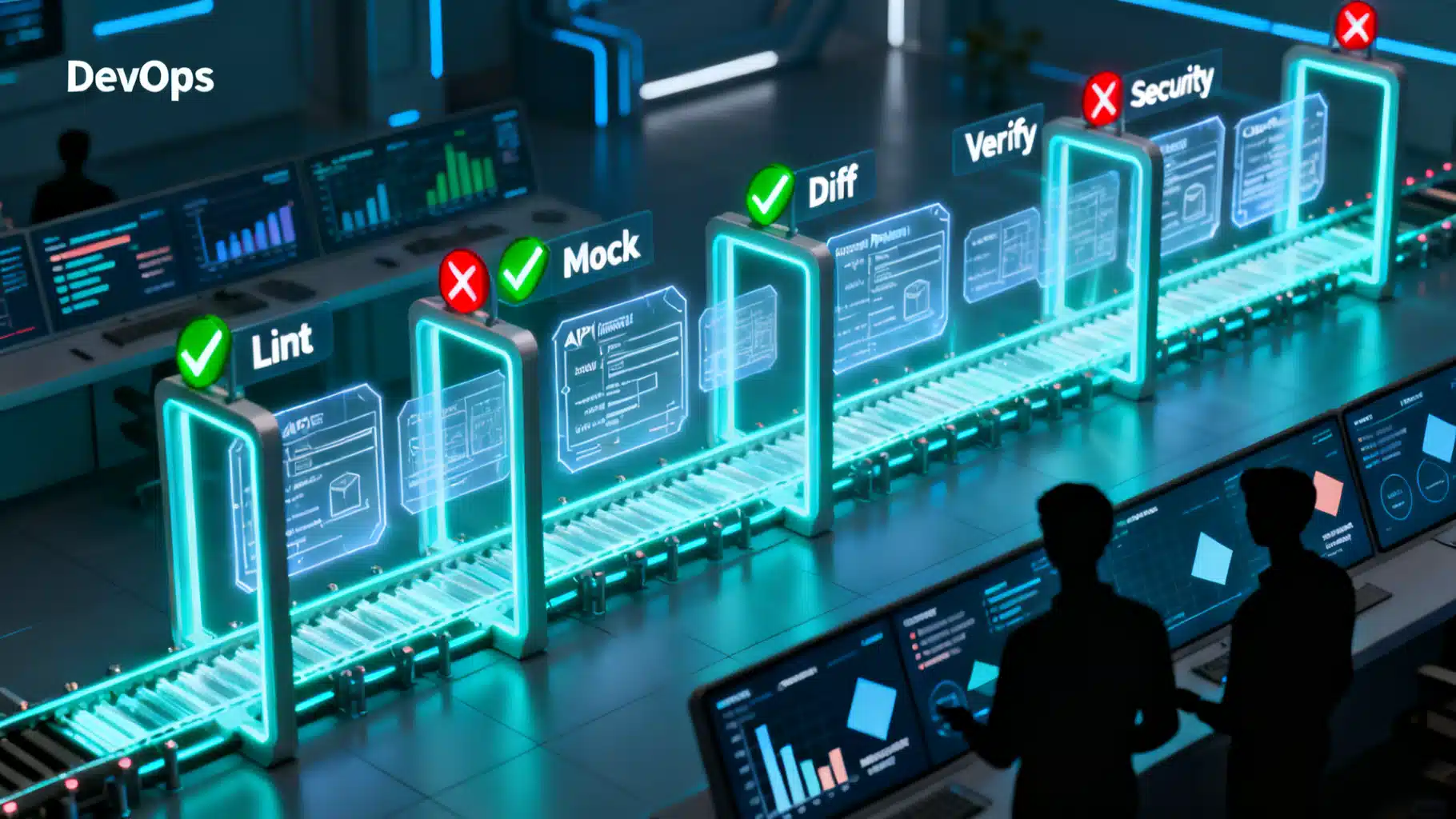
Image used for representation purposes only.
Overview
API contracts are the single source of truth for how services talk to each other. A contract validation CI pipeline treats that truth like code: versioned, linted, tested, and enforced on every change. In this guide, you’ll design a pipeline that catches breaking changes before they ship, gives consumers confidence, and creates living documentation.
What “contract validation” means
Contract validation ensures that:
- The contract is syntactically correct (schema compiles).
- It meets style and governance rules (linting).
- Example payloads and tests conform to the schema.
- Proposed changes are compatible with existing consumers (breaking-change detection).
- Providers actually implement what the contract promises (provider conformance tests).
- Consumers’ expectations are honored (consumer‑driven contract testing).
- Security and performance policies are enforced as gates.
Contract-first or code-first?
- Contract-first: You design the contract (OpenAPI/AsyncAPI/GraphQL SDL) first, generate stubs/clients, then implement. Best for strong governance and reuse.
- Code-first: You annotate code and generate the contract as a build artifact. Faster for greenfield teams; add strict CI gates to avoid drift.
Either way, the pipeline treats the contract artifact as the canonical interface.
Choosing your contract format
- REST/HTTP: OpenAPI 3.x + JSON Schema for payloads.
- Event-driven: AsyncAPI + JSON Schema or Avro (with a schema registry).
- GraphQL: SDL + persisted queries and schema checks.
The rest of this article uses OpenAPI for examples, with notes for events.
Pipeline architecture at a glance
- Fetch contract (changed files in PR).
- Lint and validate schema.
- Build artifacts (clients/servers), optionally dry-run generation.
- Spin up a mock server and validate examples.
- Run property-based tests against the spec.
- Detect breaking changes against the latest released contract.
- Verify provider implementation against the contract.
- Verify consumer contracts (CDCT) from pact files.
- Run security checks (auth flows, headers, known bad patterns).
- Publish docs and versioned artifacts after main-branch merge.
Quality gates block merges if any step fails.
A minimal OpenAPI example
openapi: 3.0.3
info:
  title: Orders API
  version: 1.3.0
paths:
  /orders/{id}:
    get:
      summary: Get an order by ID
      parameters:
        - in: path
          name: id
          required: true
          schema: { type: string }
      responses:
        '200':
          description: OK
          content:
            application/json:
              schema:
                $ref: '#/components/schemas/Order'
components:
  schemas:
    Order:
      type: object
      required: [id, status]
      properties:
        id: { type: string }
        status: { type: string, enum: [CREATED, SHIPPED, CANCELLED] }
Governance and linting
Linting enforces consistency (naming, descriptions, error shape, pagination params). Create a ruleset once and reuse across repos.
Example Spectral ruleset:
# .spectral.yaml
extends: spectral:oas
rules:
  info-contact: off
  operation-tags: warn
  operation-description:
    description: Operations must have descriptions
    given: $.paths[*][*]
    severity: error
    then:
      field: description
      function: truthy
  error-response-shape:
    description: 4xx/5xx must return Problem Details
    given: $.paths[*][*].responses[/(?^(4|5)\d{2}$)/].content.application\/json.schema
    severity: error
    then:
      function: schema
      functionOptions:
        schema:
          type: object
          required: [title, status]
Breaking-change detection
Compare the PR’s contract to the latest released baseline. Flag removals, narrowed enums, required fields added, or tightened constraints.
Typical rules:
- Removing an endpoint/field = breaking.
- Making a required property out of an optional one = breaking.
- Narrowing enum or min/max range = breaking.
- Widening constraints or adding optional fields = non‑breaking.
Tools: openapi-diff/oasdiff for REST, registry diff for Avro/AsyncAPI, GraphQL schema diff tools for SDL.
Provider conformance tests
Ensure the running service responds as the contract states. Two approaches:
- Contract test runners (e.g., Dredd, Schemathesis) that execute requests from the spec and validate responses.
- Generated test suites that hit your dev container or ephemeral environment.
Property-based tests with Schemathesis are powerful for edge cases.
Consumer-driven contract testing (CDCT)
Consumers publish pacts (their expectations). Providers verify against these pacts in CI. This prevents “compatible-but-useless” changes and captures real-world usage. Use a broker to share pacts and coordinate verifications across teams and versions.
Security checks as code
Automate checks for:
- Authentication flows present (e.g., OAuth2 securitySchemes) for protected endpoints.
- Mandatory headers (Correlation-Id, Content-Type).
- Disallowing wildcards in CORS for production specs.
- Response examples not leaking secrets.
- Known CWE/OWASP pitfalls (e.g., returning stack traces).
Implementation: GitHub Actions workflow
# .github/workflows/api-contract-ci.yml
name: API Contract Validation
on:
  pull_request:
    paths: ["**/*.yaml", "**/*.yml", "**/*.json", "src/**"]
  push:
    branches: [ main ]

jobs:
  lint-validate:
    runs-on: ubuntu-latest
    steps:
      - uses: actions/checkout@v4
      - uses: actions/setup-node@v4
        with: { node-version: '20' }
      - name: Install tooling
        run: |
          npm i -g @stoplight/spectral-cli @redocly/cli oasdiff
          python -m pip install --upgrade pip schemathesis
      - name: Lint OpenAPI
        run: spectral lint openapi.yaml --fail-severity=warn
      - name: Validate OpenAPI
        run: redocly lint openapi.yaml --max-problems=0
      - name: Mock server (background)
        run: npx @stoplight/prism-cli mock -p 4010 openapi.yaml &
      - name: Property-based tests
        run: schemathesis run http://127.0.0.1:4010 --checks=all --hypothesis-deadline=0
      - name: Detect breaking changes vs baseline
        run: |
          git fetch --depth=1 origin main
          git show origin/main:openapi.yaml > baseline.yaml
          oasdiff diff --fail-on-breaking baseline.yaml openapi.yaml

  provider-verify:
    needs: [lint-validate]
    runs-on: ubuntu-latest
    services:
      app:
        image: ghcr.io/acme/orders-service:pr-${{ github.event.number }}
        ports: ["8080:8080"]
        options: >-
          --health-cmd="curl -f http://localhost:8080/health || exit 1" --health-interval=5s --health-timeout=2s --health-retries=20
    steps:
      - uses: actions/checkout@v4
      - name: Verify provider against OpenAPI
        run: |
          python -m pip install schemathesis
          schemathesis run http://localhost:8080 --schema=openapi.yaml --checks=all

  consumer-contracts:
    needs: [lint-validate]
    runs-on: ubuntu-latest
    steps:
      - uses: actions/checkout@v4
      - name: Fetch consumer pacts
        run: ./scripts/pact/pull.sh # pulls latest verified consumer pacts from broker
      - name: Verify pacts
        run: ./scripts/pact/verify.sh http://localhost:8080

  publish-docs:
    if: github.ref == 'refs/heads/main' && github.event_name == 'push'
    needs: [lint-validate, provider-verify]
    runs-on: ubuntu-latest
    steps:
      - uses: actions/checkout@v4
      - name: Build docs
        run: npx @redocly/cli build-docs openapi.yaml -o site/index.html
      - name: Upload artifact
        uses: actions/upload-pages-artifact@v3
        with: { path: 'site' }
      - name: Deploy to Pages
        uses: actions/deploy-pages@v4
Notes:
- For monorepos, replace openapi.yaml with a matrix strategy over all specs in the repo.
- Use branch protection so PRs can’t merge unless all three jobs pass.
GitLab CI variant (sketch)
stages: [lint, test, verify, release]

lint:
  image: node:20
  stage: lint
  script:
    - npm i -g @stoplight/spectral-cli @redocly/cli oasdiff
    - spectral lint openapi.yaml --fail-severity=warn
    - redocly lint openapi.yaml --max-problems=0
  only: [merge_requests]

diff:
  image: node:20
  stage: test
  script:
    - oasdiff diff --fail-on-breaking baseline.yaml openapi.yaml

provider_verify:
  image: python:3.12
  stage: verify
  services:
    - name: $CI_REGISTRY_IMAGE/orders-service:$CI_COMMIT_SHA
  script:
    - pip install schemathesis
    - schemathesis run http://orders-service:8080 --schema=openapi.yaml --checks=all
Handling event-driven APIs
- Use AsyncAPI to describe channels, messages, and bindings.
- Validate message payloads against JSON Schema or Avro.
- Diff message schemas using a registry tool; treat field removals or type narrowing as breaking.
- Use consumer contracts: producers verify they can publish messages that consumers can parse; consumers verify they can handle producer messages.
Example Avro schema snippet:
{
  "type": "record",
  "name": "OrderCreated",
  "namespace": "acme.orders",
  "fields": [
    { "name": "id", "type": "string" },
    { "name": "status", "type": { "type": "enum", "name": "Status", "symbols": ["CREATED","SHIPPED","CANCELLED"] } }
  ]
}
Versioning and release flow
- Use semantic versioning on the contract:
- MAJOR for breaking changes.
- MINOR for backward-compatible additions.
- PATCH for fixes and docs only.
- Keep at least one deprecated window (e.g., 90 days) for consumers to migrate.
- Publish versioned artifacts: docs, generated SDKs, and a tag in your registry.
Environments and ephemeral stacks
- Spin up an ephemeral environment per PR to run provider verification against real implementations and data fixtures.
- Seed with synthetic data; avoid PII.
- Tear down automatically to control cost.
Caching, parallelism, and speed
- Cache npm/pip toolchains by lockfile.
- Run lint, diff, and mock tests in parallel.
- Shard spec-based tests by operationId.
- Fail fast: if the diff job finds breaking changes, cancel downstream jobs.
Observability and reporting
- Post PR comments summarizing:
- New endpoints and fields.
- Potentially breaking changes.
- Links to preview docs and mock server.
- Export junit/HTML reports from test runners; surface in your CI UI.
- Track SLOs: time-to-approve a contract, flaky-test rate, rollback counts.
Common failure modes and fixes
- “It works locally but fails in CI”: Pin tool versions and run the same container image locally and in CI.
- “False positives on diff”: Maintain an ignore list for known-safe changes (e.g., description edits). Review periodically.
- “Spec drift”: For code-first, generate contracts during build and compare to the hand‑authored spec. Block merges on drift.
- “Flaky property-based tests”: Increase strategy timeouts, seed deterministically, record shrunk examples.
- “Security drift”: Add a rule requiring securitySchemes on non-public operations.
Minimal checklist
- Contract compiles and lints with custom rules.
- Examples validated via mock server.
- Property-based tests run against spec and provider.
- Breaking-change detection vs latest release.
- Consumer pacts verified.
- Security checks enforced.
- Docs and artifacts published on main merge.
- Branch protection requires all checks.
Conclusion
A contract validation CI pipeline moves API quality left. By automating linting, example validation, diffing, provider and consumer tests, and security checks, you turn risky interface changes into routine, reviewable, and reversible events. Start small—lint and diff on PRs—then layer in provider verification, CDCT, and security gates. Your services and your consumers will thank you.
Related Posts
Consumer‑Driven Contract Testing for APIs: A Practical Guide
Learn how consumer‑driven contract testing works, why it matters, and how to implement it for REST, GraphQL, and event-stream APIs with CI/CD integration.
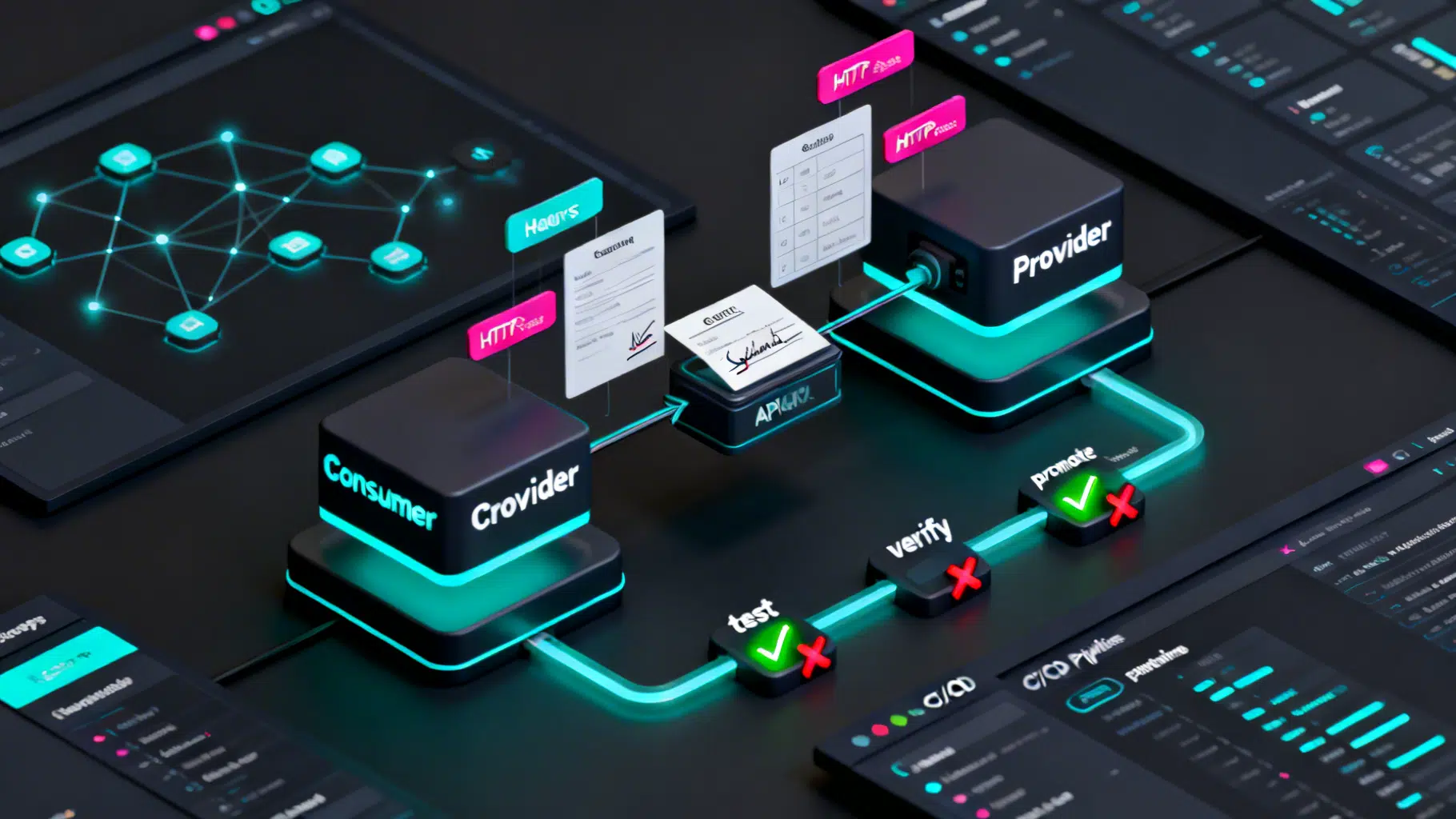
Consumer-Driven Contract Testing: A Practical Guide to Safer, Faster API Delivery
A practical guide to consumer-driven contract testing: how it works, why it matters, and how to implement it with CI/CD to ship APIs faster without breaks.
Practical Strategies for API Integration Testing: From Contracts to Chaos
A practical guide to API integration testing: contracts, data, environments, tooling, CI/CD, performance, security, and resilience.