Designing Robust GraphQL Schemas: Best Practices for Real-World APIs
Practical best practices for GraphQL schema design: naming, nullability, pagination, mutations, errors, auth, performance, and governance.
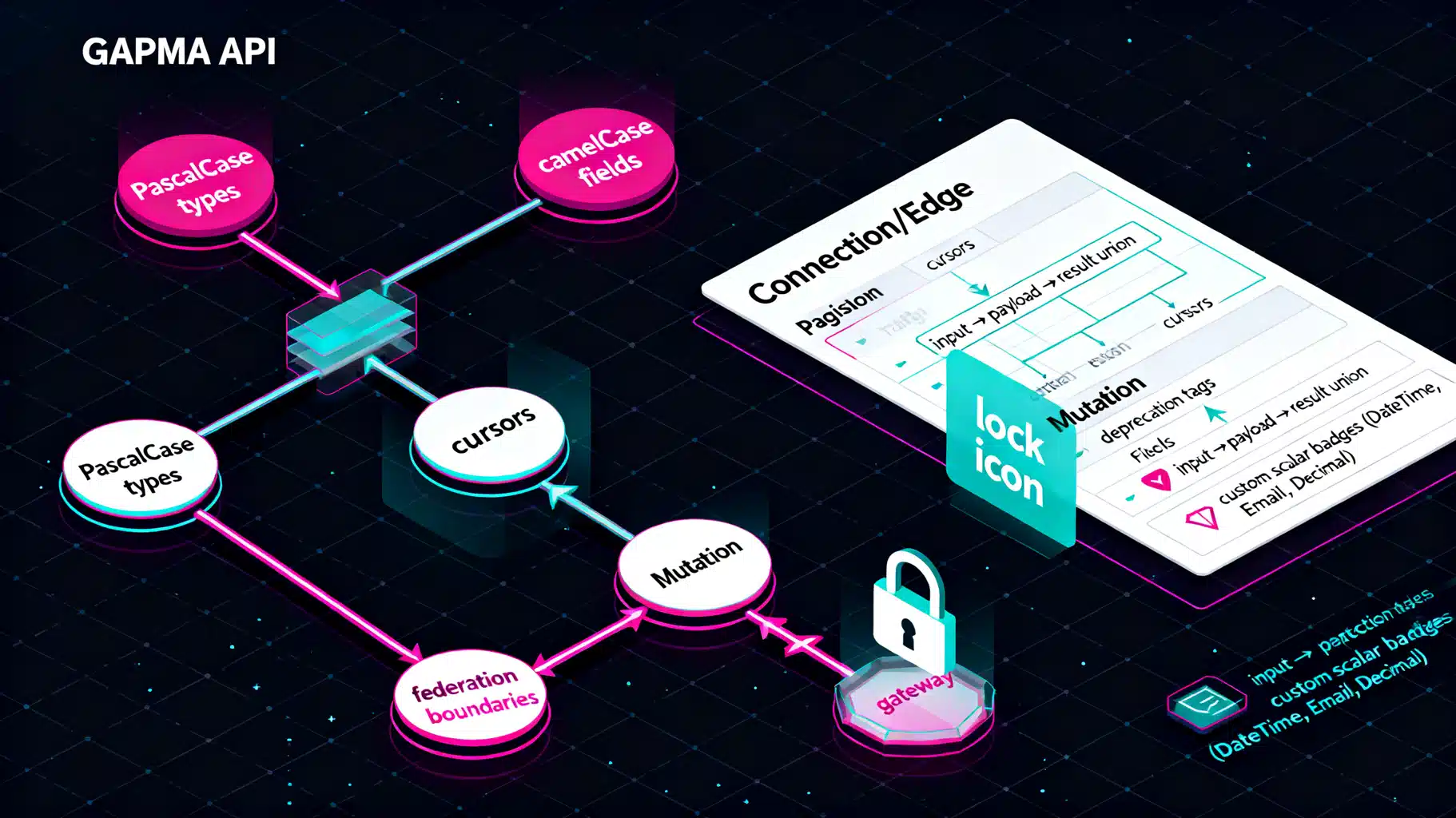
Image used for representation purposes only.
Introduction
A GraphQL schema is your API’s contract. It shapes developer experience, system performance, and the ease with which your platform can evolve. This guide distills field‑tested best practices for designing robust, consistent, and future‑proof GraphQL schemas. Whether you maintain a monolith or a federated graph, these patterns will help you ship faster with fewer breaking changes.
Core Principles
- Consumer-first: Model data and operations around client use cases, not database tables.
- Explicit over implicit: Prefer strong types, descriptive names, and documented behaviors.
- Evolvability: Design so you can add features without breaking clients.
- Consistency: Use uniform naming, pagination, and error conventions across the graph.
- Least surprise: Follow community norms where they exist.
Naming Conventions
- Types: PascalCase (e.g.,
User,OrderItem). - Fields & arguments: camelCase (e.g.,
displayName,createdAt,first,after). - Mutations: Imperative verbs in PascalCase (e.g.,
CreateUser,CancelOrder). The field onMutationis camelCase (e.g.,createUser). - Connections: Plural for collections and a
Connection/Edgesuffix for Relay-style pagination. - Avoid abbreviations and overloaded names; prefer clarity (
shippingAddressoveraddr).
# Good
type User {
  id: ID!
  displayName: String!
  email: Email
  createdAt: DateTime!
}

# Less ideal
type usr {
  ID: ID
  name: String
  e: String
  created: String
}
Types and Nullability
GraphQL’s nullability is a power tool. Use it to communicate guarantees and to allow partial results.
- Default to non-null for required fields (
String!) when you can uphold the contract. - Use nullable fields for data that may be absent due to permissions, partial failures, or true absence.
- Avoid non-null cycles across relationships that make object creation impossible.
- For inputs, express optionality deliberately and provide sensible defaults.
type Profile { bio: String, avatarUrl: URL }
# Optional fields let servers return partial data when a downstream system fails.

input UpdateProfileInput {
  bio: String
  avatarUrl: URL
}
Stable IDs and the Node Interface
- Provide globally unique, opaque IDs for all top-level entities. Do not leak database keys.
- Consider implementing the Relay
Nodeinterface to standardize id lookup.
interface Node { id: ID! }

type User implements Node { id: ID!, displayName: String! }

type Query {
  node(id: ID!): Node
  user(id: ID!): User
}
Pagination: Prefer Cursors and Connections
Offset-based pagination is simple but brittle at scale. Cursor-based patterns yield better stability and performance.
- Use
Connection/Edgetypes withedges { node, cursor }andpageInfo { hasNextPage, endCursor }. - Accept
first/after(forward) andlast/before(backward) arguments for symmetry. - Avoid exposing
totalCountif it’s expensive; consider approximate counts or a separate, cached field.
type UserConnection {
  edges: [UserEdge!]!
  pageInfo: PageInfo!
}

type UserEdge { node: User!, cursor: String! }

type PageInfo {
  hasNextPage: Boolean!
  hasPreviousPage: Boolean!
  startCursor: String
  endCursor: String
}

extend type Query {
  users(first: Int = 20, after: String): UserConnection!
}
Mutations: Input/Output Payload Pattern
- Model each mutation as a single, focused operation.
- Use an
inputobject for stability over time and easy argument evolution. - Return a payload object with the modified entity and useful edge fields.
- Prefer idempotent operations where possible; make side effects explicit.
type Mutation {
  createUser(input: CreateUserInput!): CreateUserPayload!
}

input CreateUserInput {
  displayName: String!
  email: Email!
}

type CreateUserPayload {
  user: User
  # optional metadata for client convenience
  clientMutationId: String
}
Enums and Custom Scalars
- Prefer
enumover free-form strings when the set of values is small and well-defined. - Use custom scalars for domain primitives that need validation/formatting:
DateTime,URL,Email,Decimal,UUID. - For money, avoid floating-point. Use a
Moneyobject or an exactDecimalscalar.
scalar DateTime
scalar Email
scalar URL
scalar Decimal

type Money { amount: Decimal!, currency: CurrencyCode! }

enum CurrencyCode { USD EUR GBP JPY }
Interfaces and Unions for Polymorphism
- Use
interfacewhen types share fields and behavior; it improves reuse and discoverability. - Use
unionfor disjoint alternatives where shared fields don’t make sense.
interface SearchResult { id: ID!, preview: String! }

type User implements SearchResult { id: ID!, preview: String!, displayName: String! }

type Article implements SearchResult { id: ID!, preview: String!, title: String! }

union FeedItem = Article | Promotion
Documentation and Descriptions
- Document every type, field, argument, and enum value with meaningful descriptions.
- Include examples and edge cases in descriptions when helpful.
- Keep descriptions updated with behavior changes, not just code comments.
"""A user-visible name. Not guaranteed unique."""
scalar DisplayName

"""
Fetch a user by ID. Returns null if the user does not exist or is not visible to the caller.
"""
user(id: ID!): User
Deprecation and Versioning
Avoid versioned endpoints. GraphQL is built for additive evolution.
- Use
@deprecated(reason: "...")on fields, enum values, and input fields. - Adopt a deprecation policy with timelines (e.g., announce → deprecate → remove after 6–12 months).
- Introduce new fields instead of changing semantics in place.
- If breaking changes are unavoidable, batch them, communicate explicitly, and provide migration guides.
"""Use `primaryEmail` instead."""
email: Email @deprecated(reason: "Replaced by primaryEmail for multi-email support")
Errors: Clear, Structured, and Predictable
Top-level GraphQL errors are great for transport and validation issues. For domain/business errors, prefer typed results.
Patterns:
- Payload pattern with a typed
errorfield or discriminated union. - Include stable error codes and user-facing messages separately.
type CreateUserPayload {
  user: User
  error: CreateUserError
}

enum CreateUserErrorCode { DUPLICATE_EMAIL INVALID_INPUT PERMISSION_DENIED }

type CreateUserError {
  code: CreateUserErrorCode!
  message: String! # human-readable, localizable on client
  field: String
}
If you surface top-level errors, use extensions.code for machine-readable categories and avoid leaking internals.
Authorization and Privacy
- Enforce auth in resolvers; the schema documents policy but is not the policy.
- Prefer returning
nullfor unauthorized nullable fields and masking IDs when necessary; avoid data leakage via error messages. - Use a
viewerormefield to anchor access to the caller’s perspective. - Consider field-level authorization and consistent permission semantics across subgraphs/services.
type Query { me: User }
Performance and N+1 Avoidance
- Batch and cache data fetching with tools like DataLoader or equivalent batching mechanisms.
- Avoid expensive defaults; require explicit arguments for heavy operations (e.g.,
includeArchived: Boolean = false). - Use selection-set awareness to fetch only requested columns/relations when possible.
- Precompute or denormalize read-heavy aggregations behind stable fields.
Query Safety and Limits
- Enforce maximum query depth and node counts; cap list sizes with sensible defaults.
- Apply server-side timeouts and input size limits.
- Consider complexity scoring or cost directives to reject pathological queries.
- Rate limit per identity and per client; throttle mutations that modify hot resources.
Caching and Delivery
GraphQL changes HTTP caching dynamics, but you still have options:
- Automatic Persisted Queries (APQ): exchange a query hash for the full document; enables CDN caching and smaller payloads.
- Persisted GET queries: use GET for cacheable reads with appropriate Cache-Control headers.
- Response caching: cache resolver results where safe; combine with short TTLs and invalidation hooks.
- Client-side normalization: design stable entity IDs to maximize cache hits in clients like Apollo or Relay.
- Cache hints: attach cache metadata per field to guide downstream caches.
Directives and Reuse
- Built-ins like
@deprecatedare essential; use them liberally with reasons. - Introduce custom directives sparingly (e.g.,
@cost,@private,@cacheControl) and back them with server/runtime support. - Avoid encoding business rules purely in directives without enforcement.
Federation and Modularization
For larger organizations, a modular or federated graph keeps teams decoupled.
- Define clear ownership per schema module or subgraph.
- Standardize shared scalars, conventions, and error codes across teams.
- Keep boundaries clean—prefer referencing by IDs and gateway-level entity resolution over cross-service backdoors.
- Document keys and entity representations; avoid leaking internal service models.
Schema Governance and Tooling
- Lint for style and anti-patterns (e.g.,
graphql-schema-linter). - Use a schema registry to track changes, history, and client impacts.
- Add contract tests: ensure popular operations still compile and behave across releases.
- Automate breaking-change detection in CI, with human review for risk.
- Generate types/SDKs from the schema for both server and clients.
Practical SDL Examples
Collection with Connection
extend type Query {
  repository(owner: String!, name: String!): Repository
}

type Repository implements Node {
  id: ID!
  name: String!
  owner: User!
  issues(first: Int = 20, after: String): IssueConnection!
}

type IssueConnection {
  edges: [IssueEdge!]!
  pageInfo: PageInfo!
}

type IssueEdge { node: Issue!, cursor: String! }

type Issue implements Node {
  id: ID!
  title: String!
  state: IssueState!
  createdAt: DateTime!
}

enum IssueState { OPEN CLOSED }
Mutation with Typed Errors
type Mutation {
  closeIssue(input: CloseIssueInput!): CloseIssueResult!
}

input CloseIssueInput { issueId: ID!, reason: CloseReason }

enum CloseReason { COMPLETED NOT_PLANNED DUPLICATE }

union CloseIssueResult = CloseIssueSuccess | CloseIssueProblem

type CloseIssueSuccess { issue: Issue! }

type CloseIssueProblem {
  code: CloseIssueErrorCode!
  message: String!
}

enum CloseIssueErrorCode { NOT_FOUND PERMISSION_DENIED INVALID_STATE }
Checklist for a Healthy Schema
- Consistent naming across the graph.
- Non-null by default; null where absence is expected.
- Cursor-based pagination with connections for large lists.
- Mutations follow input/payload or result-union patterns with typed errors.
- Enums and custom scalars for domain clarity and validation.
- Document everything; deprecate with reasons and timelines.
- Batch data fetching; enforce query depth/complexity limits.
- Apply caching strategies: APQ, persisted GET, and cache hints.
- Govern with linting, schema registry, and automated checks.
Conclusion
Great GraphQL schemas feel obvious in hindsight: consistent names, predictable shapes, and clear contracts that evolve gracefully. By leaning on strong typing, standard patterns for pagination and mutations, and disciplined governance, you give clients confidence and your teams room to move quickly without breaking things. Start with these practices, measure how they land with your consumers, and refine the contract continuously as your product grows.
Related Posts

GraphQL Schema Design Best Practices: A Practical Guide
Practical best practices for GraphQL schema design: naming, types, pagination, nullability, errors, auth, evolution, and performance.
GraphQL Pagination: Offset, Cursor, and Relay Connections Explained
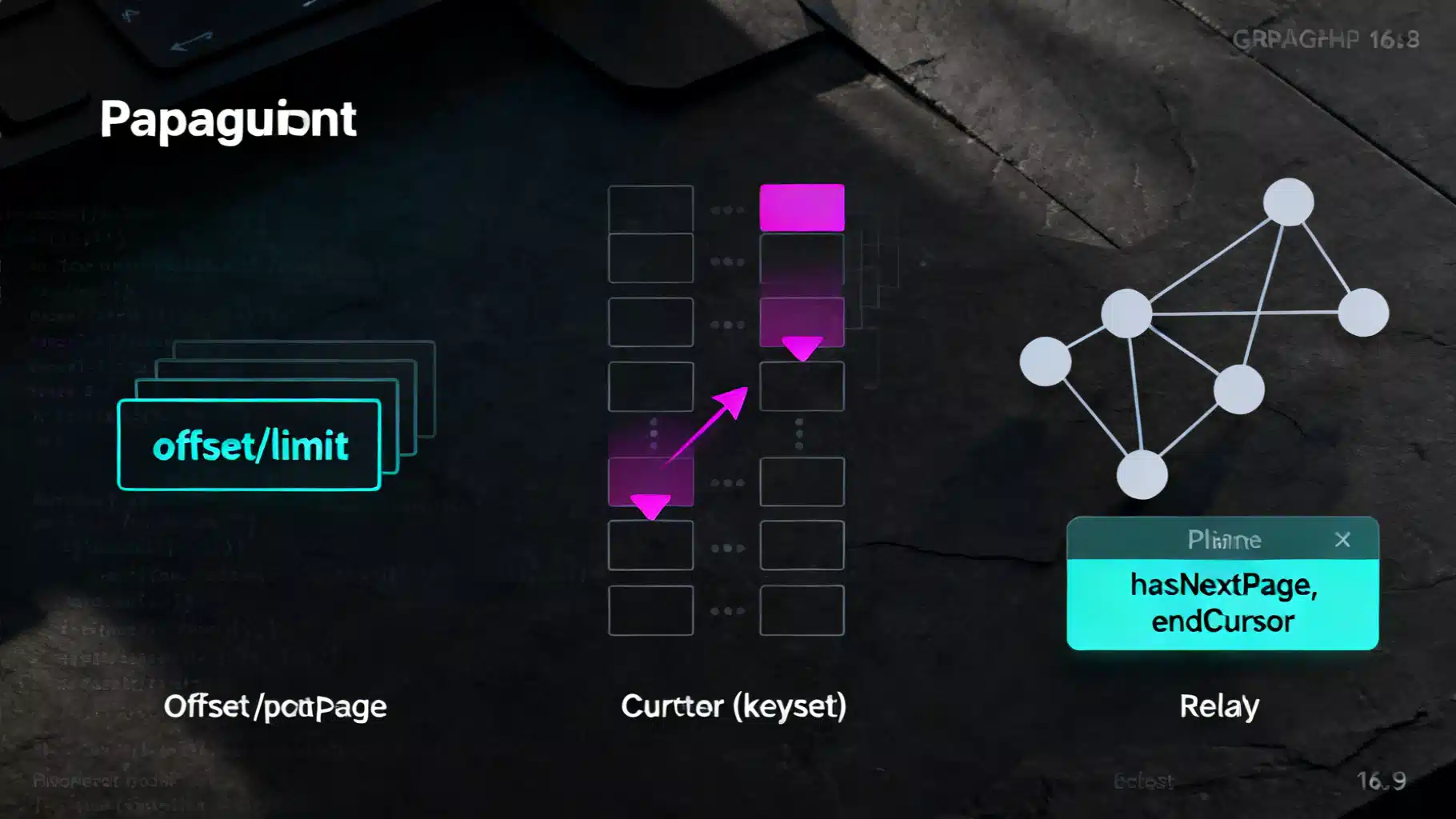
A practical guide to GraphQL pagination: offset, cursor (keyset), and Relay Connections—trade-offs, SQL patterns, and battle-tested implementation tips.

Field‑Level Permissions in GraphQL: Patterns, Code, and Production Tactics
A practical guide to implementing secure, fast, and auditable field-level permissions in GraphQL—patterns, code examples, and production pitfalls.