
Starlink’s Next Phase: Spectrum Power Play, Starship V3 Capacity, and a Growing Mobile Footprint
Starlink’s breakout week: U.S. spectrum deal, first Starship‑deployed V3 satellites, aviation surge—and Ukraine reports service restored.
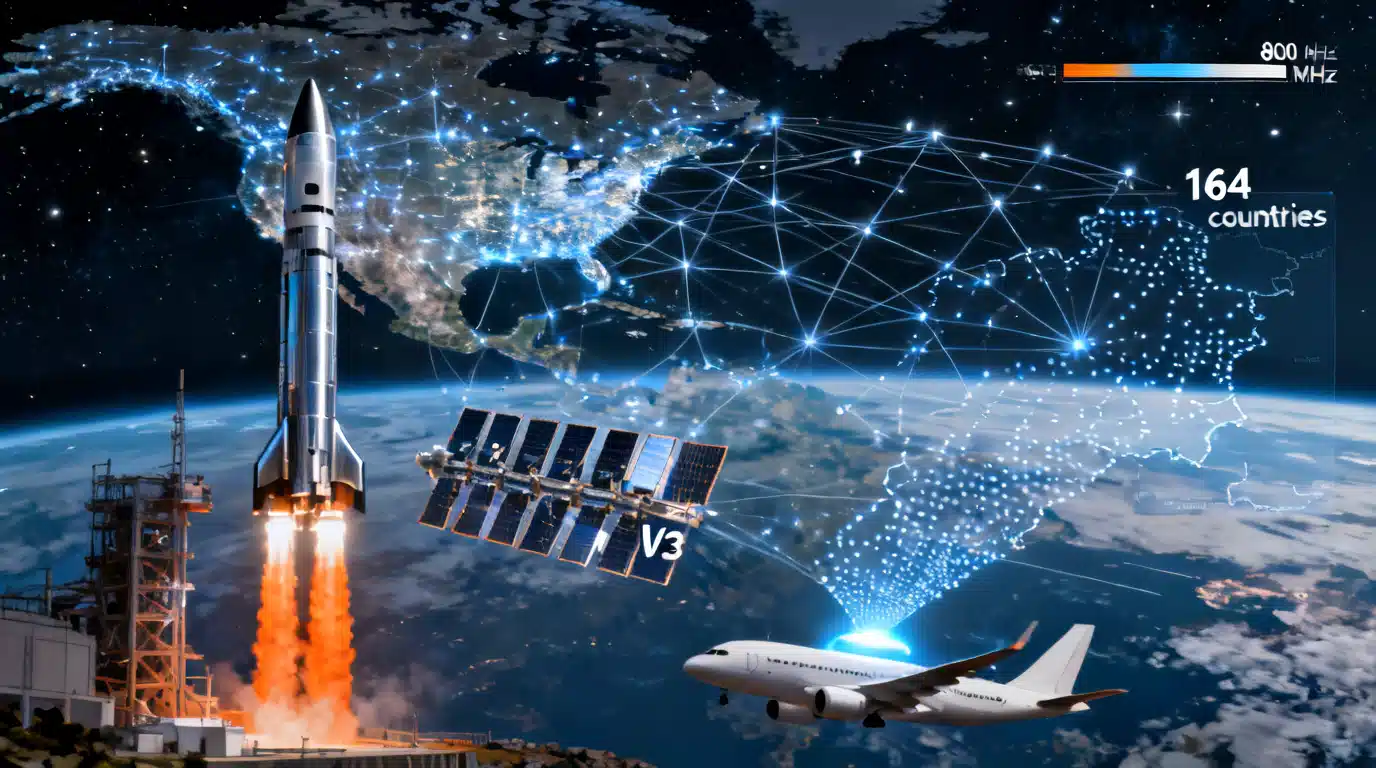
Image used for representation purposes only.
Starlink’s pivotal week: spectrum deal, Starship V3 capacity online, aviation surge—and Ukraine service restored
SpaceX’s Starlink is executing a rapid shift from “satellite ISP” to full‑stack connectivity platform. In the last week alone, SpaceX agreed to buy nationwide low‑band spectrum in the U.S., its Starship rocket placed the first operational Starlink V3 satellites into orbit, United Airlines said nearly half its daily flights now offer Starlink Wi‑Fi, and Kyiv reported that throttled Starlink/Starshield services were restored to full capacity. Together, these moves underscore how Starlink is expanding from fixed broadband into mobility and direct‑to‑cell, while its role in geopolitics remains fraught. (prnewswire.com )
The big strategic move: low‑band spectrum for “Starlink Mobile” in the U.S.
On October 8–9, SpaceX reached a definitive agreement to acquire Grain Management’s nationwide 800 MHz portfolio—up to 14 MHz of paired, low‑band spectrum often prized for penetrating buildings and broad coverage. Reporting pegs the transaction at roughly $8 billion. The deal follows FCC action in July that enabled a T‑Mobile/Grain swap of 800 MHz and 600 MHz licenses, with conditions encouraging partnerships for direct‑to‑device (D2D) operations. SpaceX’s new spectrum complements higher‑band holdings and its satellite assets, positioning “Starlink Mobile” to compete more directly in U.S. telecom once buildout and approvals advance. (prnewswire.com )
Why it matters: Starlink already operates a live satellite‑to‑mobile messaging service in select countries and counts millions of monthly active devices using satellite messaging/OTT voice. Low‑band spectrum could help close indoor‑coverage gaps and support terrestrial small cells that backhaul over Starlink, a hybrid model that industry analysts and carriers have debated in recent days. (starlink.com )
Scale and performance by the numbers
According to SpaceX’s June 5, 2026 EU prospectus, Starlink had approximately 10.3 million subscribers across 164 countries, territories, and markets as of March 31, 2026. Median residential download speeds during peak hours were about 225 Mbps, with ~25 ms median latency, reflecting the network’s global footprint and dense laser‑linked LEO mesh. (content.spacex.com )
As of October 14–15, independent trackers drawing on CelesTrak data put the constellation at roughly 11,100–11,150 Starlink satellites in orbit, with small day‑to‑day variance as launches and deorbits occur. That scale dwarfs every other constellation and underpins Starlink’s ability to add capacity quickly as demand grows. (keeptrack.space )
Capacity step‑change: Starship deploys first operational V3 satellites
On September 28, 2026, Starship Flight 14 reached orbit and deployed 26 next‑generation Starlink V3 satellites—the first operational payload delivered by Starship. SpaceX says each V3 is designed for about 1 Tbps of downlink capacity; deploying them on Starship is expected to increase per‑launch capacity roughly twenty‑fold versus Falcon 9. SpaceX’s update and mission pages confirm successful deployment and initial communications with all 26 craft. (spacex.com )
Industry and media accounts emphasize the strategic pivot this represents: Starship moving from sub‑orbital tests to orbital payload delivery unlocks a rapid path to densify Starlink’s capacity in key corridors. Expect additional V3 deployments and orbit‑raising in the weeks ahead, weather and regulatory windows permitting. (arstechnica.com )
Direct‑to‑cell: from texting to voice/data pilots, partner footprint grows
Starlink’s “Direct to Cell” service launched SMS messaging in early 2025, beginning in the U.S. and New Zealand, with SpaceX noting it had launched over 650 D2D‑capable satellites within 18 months. The company’s February 2025 technical brief outlined a roadmap from texting to IoT, data and voice, and its 2025 progress report said first‑generation D2D deployment had been completed. As of March 31, 2026, SpaceX reported about 7.4 million monthly unique devices using satellite messaging and OTT voice across ~30 countries. (starlink.com )
Carrier partnerships continue to expand. In Japan, KDDI announced in April 2026 that “au Starlink Direct” subscribers would gain international D2D roaming in additional countries beginning June, and two weeks ago KDDI said overseas use expanded to Australia with further partners onboarding. These moves signal growing cross‑border interoperability for satellite messaging on standard LTE handsets. (newsroom.kddi.com )
Aviation: United crosses a milestone; Southwest and Alaska accelerate
On October 15, United Airlines said Starlink Wi‑Fi is now active on more than 635 aircraft and “nearly half” of its daily departures, launching a public Starlink tracker that updates fleet progress in real time. United plans to complete installations by the end of 2027. Separately, Southwest flew its first Starlink‑equipped aircraft this summer and targets 300+ aircraft online by year‑end; Alaska Airlines began installs earlier this year and continues a fleet‑wide rollout toward completion in 2027. (united.mediaroom.com )
Hardware updates: lighter V5 residential terminal
Starlink has continued iterating its user terminals. Mid‑2026 coverage highlighted a smaller, lighter “V5” residential kit emphasizing lower power draw and easier installation relative to prior “Standard 4” hardware—useful for RVs, off‑grid sites and resilient backup. SpaceX’s prior progress reports similarly documented the compact Starlink Mini introduced in 2024. (tomshardware.com )
Policy and regulatory backdrop
In January 2026, the NTIA publicly lauded the FCC’s approval of SpaceX’s Gen2 Version 3 modification—an authorization expected to boost coverage and capacity, including for rural households funded under the U.S. BEAD program. The FCC has separately advanced rules and transactions to foster “supplemental coverage from space” (SCS) and D2D innovation, including its July 2026 order describing the T‑Mobile/Grain exchange and incentives to partner with satellite operators. These regulatory steps frame the path for Starlink’s hybrid terrestrial‑satellite ambitions. (ntia.gov )
Geopolitics: battlefield dependence and disputed throttling in Ukraine
Starlink’s pivotal role in Ukraine’s defense has repeatedly intersected with politics. On October 14, Ukrainian officials said restrictions suddenly imposed on Starlink affected the speed of drones used for defense; later, on October 15, a senior official told Axios that Starlink and Starshield services had been restored to full capacity. The episode underscores how commercial satellite networks—operated by private companies yet entwined with state interests—can become flashpoints in modern conflict. (apnews.com )
Competitive landscape
Rivals are advancing, but Starlink’s lead remains substantial. Amazon’s LEO program (rebranded “Amazon Leo”) continues multi‑launch campaigns toward commercial service, with airline partnerships slated for 2027; AST SpaceMobile is building a D2D network with U.S. carrier agreements and growing on‑orbit assets. Still, Starlink’s operational scale—double‑digit millions of subscribers and more than eleven thousand satellites—sets a high bar competitors must meet to match global coverage and capacity. (aboutamazon.com )
What to watch next
- How quickly SpaceX ramps Starship‑borne V3 deployments and how those birds translate into real‑world throughput and congestion relief in busy cells. (spacex.com )
- U.S. regulatory proceedings and potential conditions tied to low‑band spectrum use for hybrid terrestrial‑satellite service—and how incumbents respond. (docs.fcc.gov )
- Expansion of Starlink Direct to Cell beyond messaging, including early voice/data pilots with carrier partners in 2026–2027. (starlink.com )
- Airline retrofit cadence, passenger uptake, and competitive responses as more fleets light up with high‑throughput LEO connectivity. (united.mediaroom.com )
Bottom line: On October 15, 2026, Starlink sits at the center of three converging storylines—telecom disruption via spectrum and D2D, a leap in spaceborne capacity via Starship V3, and an expanding footprint across aviation and critical infrastructure. The same scale that enables that growth also amplifies Starlink’s geopolitical salience. Expect capacity and controversy to keep rising in tandem. (prnewswire.com )
Related Posts

T‑Mobile Outage Disrupts Service Nationwide; Carrier Says Network Restored After Hours
A widespread T‑Mobile outage on July 27, 2026 disrupted service nationwide; the carrier says it’s restored. Here’s what happened, what to know, and what’s next.
FCC approves Verizon’s $1 billion spectrum acquisition from Array (formerly UScellular)
On May 14, 2026, the FCC approved Verizon’s $1B purchase of spectrum from Array (ex‑UScellular), boosting 4G/5G capacity across 19 states.
5G in 2026: 5G‑Advanced arrives as fixed wireless booms and satellites go direct-to-cell
5G in 2026: 5G‑Advanced lands, fixed‑wireless surges, direct‑to‑cell matures, and U.S. spectrum auctions reboot—here’s what changed and what’s next.