Building an AI Real‑Time Collaboration API: Architecture, Protocols, and Code
Design and build an AI-powered real-time collaboration API with CRDTs, WebSockets, streaming LLMs, and production-ready patterns.
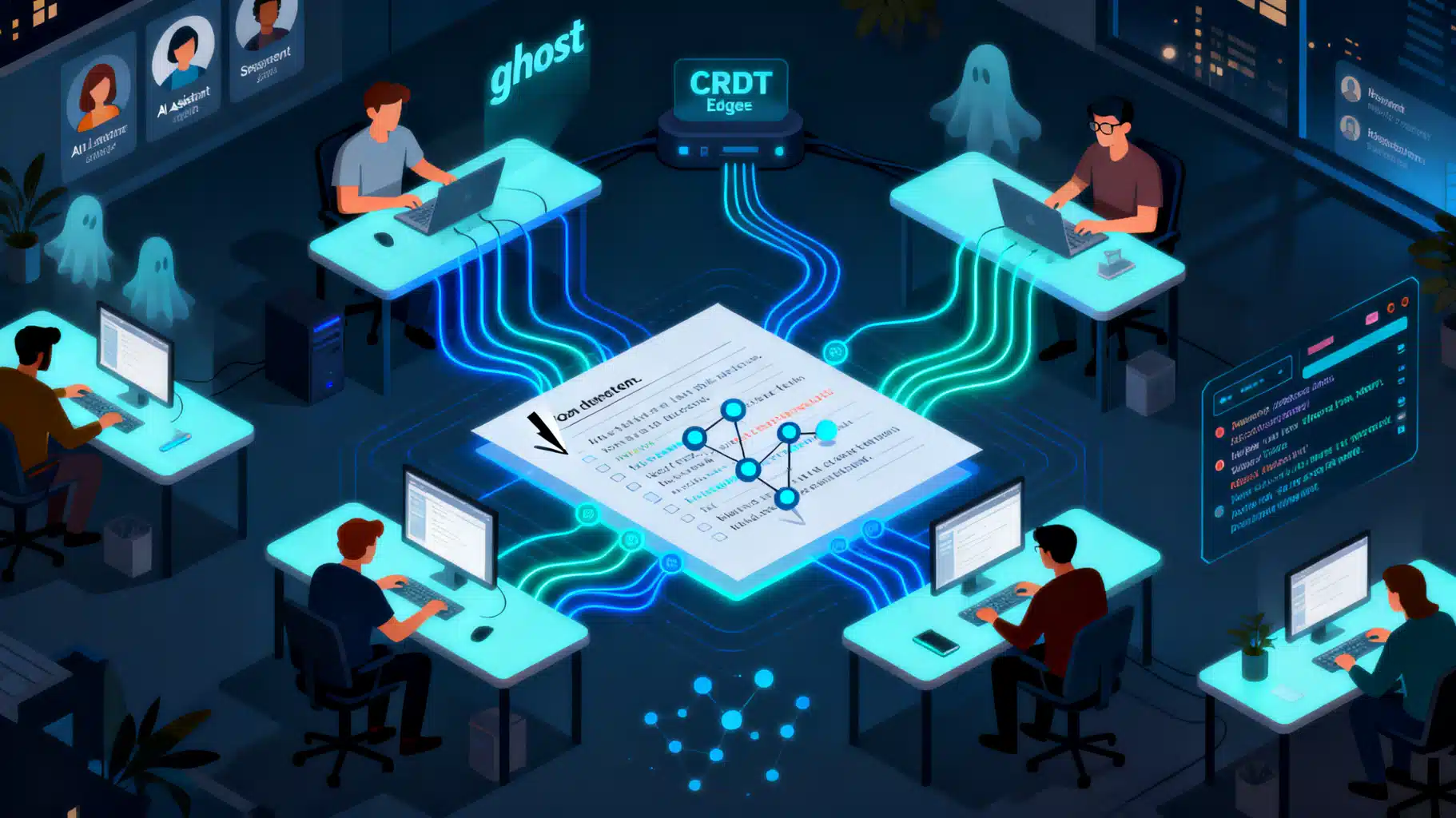
Image used for representation purposes only.
Overview
Real‑time collaboration used to mean synchronized cursors, live text edits, and presence indicators. Adding AI changes the contract: the system must stream model output alongside human edits, ground responses in the shared context, and remain consistent under bursty, bi‑directional traffic. This article explains how to design and build an AI real‑time collaboration API—from protocol and data model to latency budgets, security, and production patterns—with runnable code snippets you can adapt.
What “AI real‑time collaboration API” means
An AI real‑time collaboration API lets multiple clients and one or more AI agents co‑edit shared state (documents, whiteboards, code, canvases) with:
- Low‑latency transport (WebSockets, WebRTC, or Server‑Sent Events for fallbacks)
- Conflict‑free merging (CRDTs or OT) so human edits and model suggestions never corrupt state
- Streaming AI operations (token deltas, structured edits, tool calls) that respect the same consistency rules as humans
- Presence, roles, and moderation so the AI participates as a first‑class collaborator
Common use cases:
- Live drafting with AI: the model proposes edits inline while humans type
- Multi‑cursor code review: AI explains diffs, generates tests, or refactors selected ranges
- Design/whiteboard sessions: AI clusters sticky‑notes, titles groups, or creates diagrams
- Meeting notes: AI performs speaker diarization, summarizes, and inlines action items
Core capabilities to expose in the API
Design your surface area around these primitives:
- Sessions and rooms: join/leave, permissions, and version negotiation
- Presence: who’s here, cursors, selections, typing states
- State ops: minimal, composable edits (insert, delete, format; or CRDT ops)
- AI ops: model.start, model.delta, model.stop, tool.call, tool.result
- Context and memory: document snapshots, thread history, vector‑search retrieval
- Observability: events for audit, replay, and analytics (acceptance of AI suggestions)
- Moderation and safety: input/output filters, PII redaction, allow/deny tools
Reference architecture
A production‑grade system typically contains:
- Edge Gateway: terminates WebSockets/WebRTC; authenticates; performs rate limiting
- State Service: room membership, presence fan‑out, operation log, snapshots
- Consistency Engine: CRDT/OT merge, causality tracking, idempotency
- AI Workers: stream model tokens, call tools/functions, ground with RAG
- Vector Store / Index: retrieve contextual chunks for the current selection
- File/Blob Store: large assets referenced by ops, not inlined over the wire
- Event Bus: append‑only log for replay (e.g., to rebuild room state)
- Observability: tracing, metrics, structured logs, redaction at sinks
Data flows:
- Client authenticates and joins a room with a short‑lived token.
- Client streams presence and user ops; receives merged ops from others.
- Client requests AI assistance (e.g., “rewrite selection more concise”).
- AI Worker consumes the room’s current state, streams model deltas as ops.
- Consistency Engine merges AI ops; all clients render them incrementally.
- Event Bus records everything for audit and analytics.
Transport and protocol
- Transport: Prefer WebSockets for bi‑directional streams; support SSE for read‑only or constrained environments; optionally offer WebRTC DataChannels for peer‑heavy rooms.
- Framing: JSON envelopes with type, ts, room, client_id, seq, and causality (Lamport or vector clocks). Keep messages small and composable.
- Backpressure: sliding windows and server‑side buffering with watermarks; NAKs for dropped frames; heartbeat pings for liveness.
- Versioning: protocol_version in hello; server advertises capabilities and limits.
Minimal message envelope
{
  "type": "op|presence|ai.start|ai.delta|ai.stop|error|ack",
  "room": "doc_7f...",
  "client_id": "c_123",
  "seq": 4711,
  "ts": 1730072512345,
  "causality": { "clock": 99, "deps": ["c_42:88"] },
  "payload": { }
}
Data model: OT vs CRDT for AI co‑editing
- Operational Transformation (OT): Great for linear text editors; requires a central transformer to rebase concurrent edits. When models emit token deltas rapidly, your transformer load rises. Determinism is strong but implementation complexity grows with feature set.
- CRDTs (e.g., sequence CRDTs, JSON CRDTs): Naturally conflict‑free and peer‑mergeable; well‑suited for distributed AI workers and offline clients. Overhead per op is slightly higher, but the simplicity under concurrency (especially with multi‑agent edits) is compelling.
Guidance:
- If your primary artifact is a text buffer, start with a proven sequence CRDT.
- For rich docs/whiteboards, prefer a JSON/graph CRDT so AI can emit structured ops (create_node, set_attr, connect, tag_cluster).
AI interaction patterns
- Inline drafting: stream ai.delta ops that insert tokens at the user’s selection, guarded by a “ghost” attribution until accepted.
- Contextual tools: selection‑aware tools like summarize(range), refactor(range), title(cluster_id).
- Grounded chat: AI messages reference snapshot ids; replies include citations or object ids in the doc.
- Multi‑agent: task router delegates to specialized models (e.g., grammar, planner, refactorer) and composes their ops.
Latency budgets and performance
For collaboration to feel “live,” aim for:
- Time‑to‑first‑token (TTFT): 100–300 ms on fast paths (edge‑accelerated if possible)
- End‑to‑end op echo: < 80 ms within a region; < 200 ms cross‑region
- Steady‑state token cadence: 20–50 ms per chunk; batch tiny deltas for fewer frames
Tactics:
- Warm model contexts with speculative prompts based on user intent
- Pre‑compute retrieval indices per room and cache top‑k chunks
- Compress payloads (per‑message zstd/brotli) and deduplicate strings (interning)
- Coalesce adjacent text ops and ship JSON Patch‑like batches
Security, privacy, and governance
- Authentication: short‑lived, room‑scoped tokens; rotate every join; bind to device fingerprint where allowed.
- Authorization: role‑based (owner, editor, commenter, ai) and capability flags (can_write, can_call_tools).
- Data minimization: redact PII before sending to models; offer “local‑only” inference options.
- Content safety: input/output filters; blocklists and allowlists per room.
- Audit: immutable event log; per‑op signer; time‑boxed retention with export.
- Tenant isolation: per‑tenant encryption keys; rate/quota isolation; noisy‑neighbor protections.
Designing the API surface
Expose a small set of HTTP endpoints for auth/bootstrap and a streaming endpoint for realtime.
- POST /v1/rooms.create
- POST /v1/rooms.token (scoped, short‑lived)
- GET /v1/models (capabilities, tools)
- WS /v1/rt (real‑time multiplexed across rooms)
Example: join and collaborate (client)
const ws = new WebSocket("wss://api.example.com/v1/rt?token=ROOM_TOKEN");

ws.onopen = () => {
  ws.send(JSON.stringify({
    type: "hello",
    protocol_version: 1,
    client_id: crypto.randomUUID(),
    capabilities: { presence: true, ai: true }
  }));

  ws.send(JSON.stringify({
    type: "join",
    room: "doc_7f",
    since_clock: 0 // resume from persistence if reconnecting
  }));
};

ws.onmessage = (e) => {
  const msg = JSON.parse(e.data);
  switch (msg.type) {
    case "presence": renderCursors(msg.payload); break;
    case "op": applyCrdtOps(msg.payload.ops); break;
    case "ai.delta": applyCrdtOps(msg.payload.ops, { ghost: true }); break;
    case "ai.stop": finalizeGhostAttribution(); break;
    case "error": console.error(msg.payload); break;
  }
};

function insertTextAtSelection(text: string) {
  const ops = crdt.insert(selection.start, text);
  ws.send(JSON.stringify({ type: "op", room: "doc_7f", payload: { ops } }));
}

function askAI(action: string) {
  ws.send(JSON.stringify({
    type: "ai.start",
    room: "doc_7f",
    payload: {
      model: "editor-1",
      action, // e.g., "rewrite_concise"
      selection: selection.toJSON(),
      tools: ["search", "refactor"],
      temperature: 0.2
    }
  }));
}
Example: server skeleton (Node/TypeScript‑like pseudocode)
ws.on("message", async (msg) => {
  switch (msg.type) {
    case "op":
      const merged = consistency.merge(msg.room, msg.payload.ops, msg.client_id);
      bus.fanout(msg.room, { type: "op", payload: merged });
      break;

    case "ai.start":
      const ctx = await rooms.snapshot(msg.room, { selection: msg.payload.selection });
      const stream = ai.generate({
        model: msg.payload.model,
        system: prompts.editorSystem,
        context: retrieval(ctx),
        instruction: msg.payload.action,
        temperature: msg.payload.temperature
      });

      for await (const delta of stream) {
        const ops = aiToCrdt(delta, ctx);
        const merged = consistency.merge(msg.room, ops, "ai:" + msg.client_id);
        bus.fanout(msg.room, { type: "ai.delta", payload: { ops: merged } });
      }

      bus.fanout(msg.room, { type: "ai.stop" });
      break;
  }
});
AI delta as structured ops (example)
{
  "type": "ai.delta",
  "room": "doc_7f",
  "payload": {
    "ops": [
      { "op": "ins", "at": 128, "text": "This API ensures ", "attr": { "ghost": true } },
      { "op": "ins", "at": 144, "text": "low-latency collaboration.", "attr": { "ghost": true } }
    ],
    "trace": { "model": "editor-1", "tokens": 37, "latency_ms": 142 }
  }
}
Presence, roles, and attribution
Treat AI as a participant:
- Presence payloads include role: “ai” and capabilities
- Ghost attribution on AI edits until a human accepts or rejects
- Accept/reject events drive analytics: AI acceptance rate, time‑saved metrics
Tool calling and function orchestration
Expose a schema for tool calls so AI can act safely:
- tool.call: { name, args, call_id }
- tool.result: { call_id, result, error? }
- Allowlist tools per room; enforce argument JSON Schema; cap execution time
- Examples: search(query), refactor(range, style), summarize(nodes), translate(range, lang)
Offline, resume, and idempotency
- Resume tokens: clients reconnect with since_clock to fetch missed ops
- Idempotency keys: de‑dupe retried writes after network blips
- Snapshots: periodic room snapshots let late joiners catch up quickly
- Compacting logs: fold long token streams into coalesced ops during idle windows
Testing, quality, and observability
- Unit: CRDT/OT operation invariants and round‑trip tests
- Property: fuzz concurrent edits vs. streaming AI deltas
- Latency SLOs: TTFT p95 and echo p95 per region
- Quality: acceptance rate of AI suggestions; revert rate; time‑to‑task complete
- Safety: redaction coverage; tool call failure rates
- Observability: per‑message traces (correlate user op → AI delta → merge → render)
Deployment checklist
- Edge regions near your users; pin AI workers to the same region as rooms
- Horizontal shard by room_id; avoid hot‑shard amplification with adaptive fan‑out
- Circuit breakers: shed AI features before human‑human editing degrades
- Quotas per tenant and per room; backpressure signals to clients
- Data residency controls; encryption at rest and in flight
- Runbooks for model timeouts, partial outages, and replay from the event log
A pragmatic roadmap
- MVP: WebSocket transport, presence, sequence CRDT, ai.start/delta/stop, ghost attribution
- Phase 2: tool calling, retrieval grounding, acceptance metrics, resumable sessions
- Phase 3: multimodal (speech/vision), whiteboard graphs, peer‑to‑peer acceleration via WebRTC
- Phase 4: policy engine, enterprise governance, cross‑doc AI memory
Conclusion
An AI real‑time collaboration API succeeds when the model behaves like a respectful teammate: fast, context‑aware, and consistent. Start with a clean protocol, conflict‑free data model, and strict security boundaries. Add AI deltas as first‑class ops, measure acceptance and latency, and scale out with observability. With these patterns, you can power live editors, design canvases, and code workspaces where humans and AI genuinely build together.
Related Posts

Designing an AI Social Media Management API: Architecture, Endpoints, and Best Practices
Learn how to design and integrate an AI-powered social media management API: architecture, endpoints, models, safety, analytics, and sample code.
Prompt Chaining: Designing Reliable Multi‑Step AI Workflows
A practical guide to building robust multi-step AI pipelines with prompt chaining, orchestration patterns, state, testing, guardrails, and cost control.
API Orchestration vs. Choreography: Making the Right Integration Choice
Understand orchestration vs choreography for APIs: definitions, trade-offs, patterns, tools, and a practical decision guide.