Google Play Store, November 2026: fees, third‑party stores, cars, and AI reshaping the app economy
Google Play’s late‑2026 makeover: new fee model, U.S. third‑party stores, in‑car redesign, AI‑powered discovery, and tighter child‑safety rules.
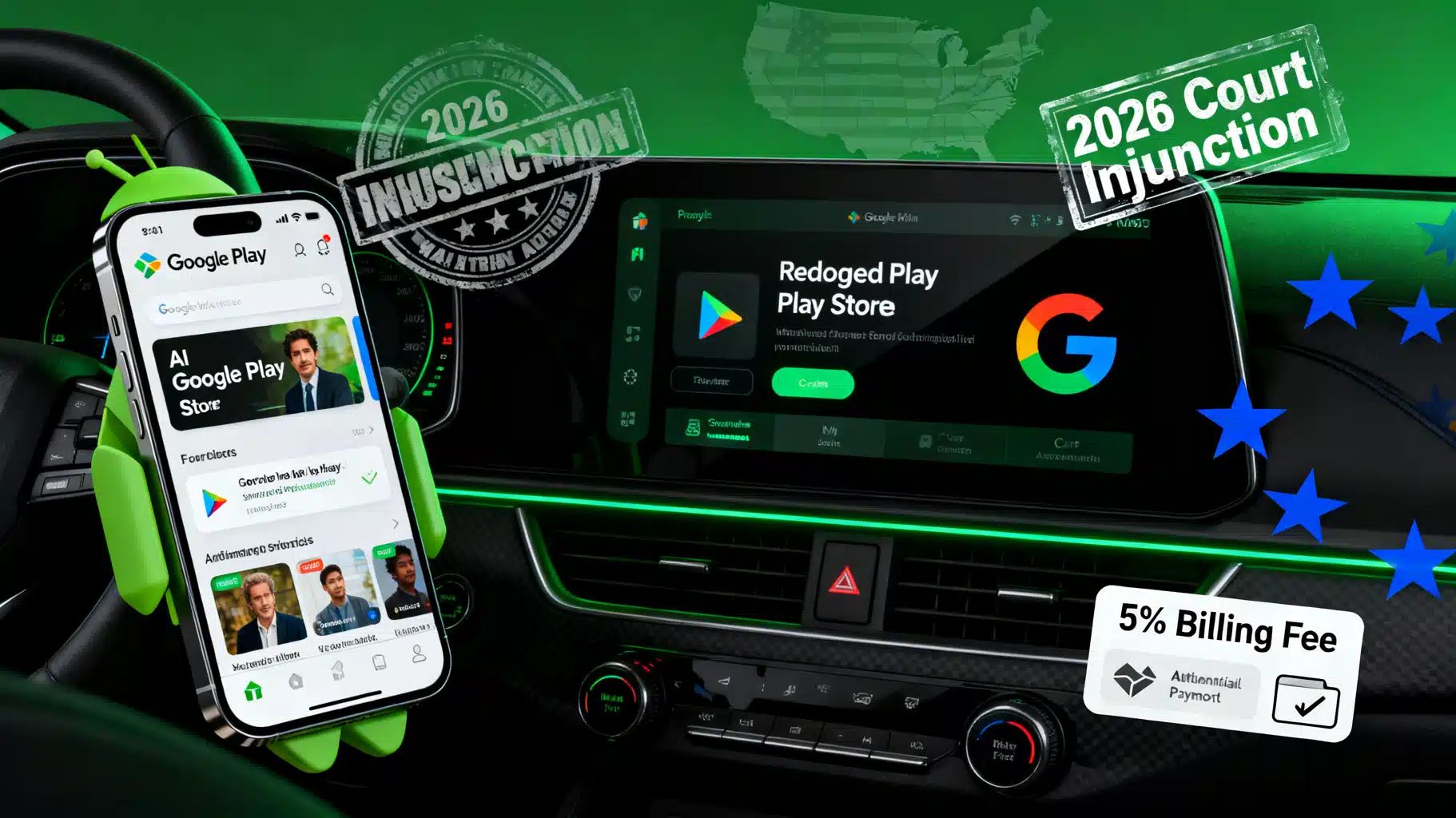
Image used for representation purposes only.
Google Play Store in late 2026: new rules, new fees, and a push beyond the phone
Google’s app marketplace is closing 2026 with some of its biggest shifts in a decade: a redesigned Play experience in cars, sweeping billing changes that separate “service” and “billing” fees, and an unprecedented opening to third‑party Android app stores in the United States. Tighter safety rules and fresh AI tooling in Play Console round out a year defined by regulation and reinvention. Here’s what’s changed—and what’s next.
The headline changes at a glance
- Billing choice expands with a new fee model, effective June 30, 2026 in the U.S., EEA, and U.K., separating a service fee (starting at 10% for the first $1M and all auto‑renewing subscriptions) from a 5% billing fee when Google Play Billing is used. Alternative billing or external web links avoid the billing fee but still incur the service fee. (android-developers.googleblog.com )
- Third‑party Android app stores can now access Google Play’s app catalog in the U.S. starting July 22, 2026, via the Play Catalog Access Program; installs complete through Google Play on standard terms. Developers could opt out for specific stores. (support.google.com )
- A redesigned Play Store is rolling out to cars with Google built‑in, adapting to different screen shapes and improving discovery of more than 700 car‑ready apps. (blog.google )
- U.S. developers may communicate prices, link to outside purchases, and offer alternative billing for users in the United States, consistent with court‑ordered changes implemented beginning October 29, 2025 and expanded programs launched December 9, 2025 and June 30, 2026. (support.google.com )
- New child‑safety rules took effect on August 26, 2026, restricting anonymous and random chat apps from targeting children and bringing more categories under age‑restricted and child‑safety policies. (developer.android.com )
Payments, fees, and “billing choice” in 2026
In June, Google detailed a global revamp of how Play handles payments. The company now distinguishes between a service fee (for distribution, discovery, and Play services) and a separate billing fee (for processing via Google Play Billing). This model launched June 30, 2026 in the United States, the European Economic Area, and the United Kingdom, with a 5% billing fee where Play Billing is used. Developers who use an alternative billing system or link out to their own website still pay the service fee but not the billing fee. (android-developers.googleblog.com )
For U.S. users specifically, Google has updated policies to comply with a federal injunction stemming from Epic Games v. Google. Since October 29, 2025, developers have been allowed to share external pricing, link to off‑Play transactions, and—under programs launched December 9, 2025—offer alternative billing within apps for U.S. users, subject to Play’s program requirements. Google’s Help Center summarizes the allowed practices and onboarding steps. (support.google.com )
Regulators continue to scrutinize the details. In Australia, for example, the competition authority authorized a settlement between Google and Epic on September 2, 2026, allowing the parties to implement agreed terms—covering service fees and how alternative payment options are displayed—through September 30, 2032. (accc.gov.au )
Third‑party stores arrive inside the Play ecosystem (U.S.)
The most radical distribution change arrived July 22, 2026: approved third‑party Android app stores in the U.S. can access the Play Catalog and offer those apps to users, with installs completed by Google Play on the same terms as a normal Play download. Developers can opt out of specific storefronts. It’s a court‑driven opening that Google has never offered before. (support.google.com )
Industry trackers note the program’s scope and caveats—third‑party stores appear via links or search (not as first‑class tabs), and Google enforces its Play policies even as it doesn’t manage those stores’ updates or payments. But for discovery and choice in the U.S., this is a meaningful new channel developers must factor into support and analytics. (9to5google.com )
Europe’s DMA and global compliance pressure
Alphabet’s Play Store remains a designated “gatekeeper” under the EU’s Digital Markets Act, with a July 16, 2026 decision detailing interoperability obligations developers can rely on—especially around access to software and hardware features under Android’s control. These duties sit alongside broader EU privacy and cybersecurity laws. (digital-markets-act.ec.europa.eu )
The European Commission’s public Q&A also highlights Google’s separate developer‑verification moves and references Google’s announcement that, starting in September 2026 in certain regions outside the EU, apps on certified Android devices must come from verified developers—changes the EU says do not apply within the bloc. (digital-markets-act.ec.europa.eu )
Google Play moves into the driver’s seat
Beyond phones, Play is rapidly expanding in cars. On October 13, 2026, Google announced a redesigned Play Store for vehicles with Google built‑in that adapts to the size and orientation of the dashboard display and improves content discovery. Media and utility apps continue to lead, but Google says the store now features hundreds of car‑ready titles, and it has graduated games for the car screen to general availability under clear controller and quality guidelines. (blog.google )
The broader in‑car roadmap is also getting smarter: a more personal version of Gemini is rolling out to vehicles through Android Auto and cars with Google built‑in, bringing voice‑driven help that draws on a user’s Google apps—within car‑specific privacy constraints. (blog.google )
AI everywhere: discovery, store listings, and labeling
Play’s discovery surface is getting a Gemini‑era refresh. At I/O 2026, Google previewed AI‑assisted discovery features such as “Ask Play” and content formats like Play Shorts, while Play Console gained Gemini‑powered workflows that localize and draft custom store listings from recommended keywords and structured files. These features promise faster iteration on creatives and metadata. (androidcentral.com )
On the operations side, Play Console’s “What’s new” page details AI chart summaries, new YouTube channel/playlist hooks for listings, and a higher app‑size ceiling (up to 4 GB for install‑time delivery plus 4 GB of post‑install asset packs)—useful for richer games and media apps. (google.play )
With AI expanding, Google also introduced an AI Asset Declaration: developers now disclose when listing visuals (icons, screenshots, videos) are AI‑generated or AI‑edited; labeled assets appear as such on Play. (support.google.com )
Safety and child‑protection updates
Google tightened several policies on August 26, 2026 to better protect minors. Anonymous and random chat apps are now covered explicitly under Families Policy Requirements, Age‑Restricted Content and Functionality, and Child Safety Standards, limiting their ability to target children and imposing stricter safeguards. Developers shipping social or chat features should review these updates closely. (developer.android.com )
For developers: key 2026–2027 dates and actions
- June 30, 2026: New global fee model begins in the U.S., EEA, and U.K.; enroll in billing‑choice programs if you plan to use alternative billing or external links. (android-developers.googleblog.com )
- July 22, 2026: U.S. Play Catalog Access Program starts; confirm your opt‑out preferences per store if needed. (support.google.com )
- August 26, 2026: Child‑safety rule updates take effect; audit chat/social features accordingly. (developer.android.com )
- September 30, 2026: Android developer verification requirements begin affecting installs in Brazil, Indonesia, Singapore, and Thailand; check Play Console to ensure all your apps are registered to avoid removal. (developer.android.com )
- Through 2026–2027: Google says steering and billing‑choice changes will continue rolling out globally (outside the U.S. under separate frameworks), with specific implementation details evolving by region. (assets.publishing.service.gov.uk )
Why this matters for users
- More choice and transparency: In the U.S., developers can link to their own purchase flows and even appear in third‑party stores that still install through Google Play. That may yield lower prices or new bundles—but also different support paths when purchases happen off‑Play. (support.google.com )
- Better experiences beyond the phone: In‑car Play is getting easier to navigate and richer in apps, while Gemini adds a voice‑first layer tailored for driving. (blog.google )
- Clearer labels for AI: Users will start seeing when store visuals are AI‑generated, adding context as generative media becomes common in listings. (support.google.com )
The road ahead
Google Play’s 2026 playbook reflects pressure from courts and regulators—and a product strategy that extends Play far beyond phones with cars, PCs, and AI‑driven discovery. Watch for:
- More regions adopting the separated service/billing fee structure and billing choice in 2027. (android-developers.googleblog.com )
- Continued DMA enforcement actions in the EU around interoperability and developer access to OS‑controlled features. (digital-markets-act.ec.europa.eu )
- Expansion of third‑party store participation in the U.S. program and developer responses (opt‑outs, support models, pricing experiments). (support.google.com )
As of November 12, 2026, the direction is clear: Google Play is becoming more open by rule and more intelligent by design. For developers and users alike, the practical impact will unfold app by app—and increasingly, car by car.
Related Posts
Google Play’s 2026 Reboot: Fees, Billing Choice, Third‑Party Stores, and AI Discovery
Google Play’s 2026 reboot: new fees, billing choice, third‑party app stores, AI discovery, and security updates—what changed and what’s next.
AI Object Detection API on Mobile: A Practical, End-to-End Tutorial
Build an Android and iOS app that streams camera frames to an AI object detection API, draws real-time boxes, and ships with production-ready patterns.
App Store adds 12‑month commitment subscriptions: annual prices, paid monthly — U.S. excluded at launch
Apple adds monthly billing with a 12‑month commitment for App Store subscriptions, rolling out in May 2026 — not initially in the U.S. or Singapore.